Quinoa Soup
Quinoa gives this soup small, tender grains that stay visible among the potatoes and vegetables. Cook the onion and tomato first, then let the dry, rinsed quinoa simmer directly in the liquid. Its starch gives the broth a little body without turning it into a purée.
This vegetable base adapts the quinoa, potato, onion, tomato, garlic and oregano combination in a Cajamarca regional health recipe booklet. It uses a smaller measured batch, olive oil, carrots and peas. It is one home-kitchen adaptation, rather than a formula for every Andean household. For comparison, Puno's official tourism inventory describes a local version with lamb, potatoes, carrots, peas and squash. The two variations below change this page's vegetable base; neither claims to reproduce that lamb soup.
Makes four generous bowls, roughly 2.2–2.4 litres in total, depending on evaporation. Allow about 1 hour 5 minutes, including 5 minutes off the heat. The quinoa and potato doneness cues matter more than the clock, particularly at higher elevations; extra simmering also adds elapsed time.
Equipment and grain choice
Use a fine-mesh sieve, a 3–4 litre heavy saucepan with a lid, a wooden spoon and a ladle. Choose packaged dry white quinoa for the stated timing. Red or black quinoa can stay firmer and take longer, so they are not the measured base here. Do not substitute 160 g of already cooked quinoa for the dry weight.
Rinsing helps remove residual bitter saponins. The FAO's International Cookbook for Quinoa describes rinsing before cooking and the translucent appearance of cooked grains. Packaged quinoa is often processed before sale, but a rinse is still useful. This recipe does not require soaking or separate precooking.
Ingredients
- 🌾 160 g dry white quinoa
- 🫒 20 ml olive oil
- 🧅 150 g onion, peeled and finely diced
- 🥕 150 g carrot, peeled and cut into 5 mm dice
- 🧄 9 g garlic, peeled and finely chopped
- 🍅 200 g ripe tomatoes, cored and finely diced
- 🥔 300 g yellow potatoes, peeled and cut into 1.5 cm cubes
- 💧 1.4 litres water
- 🌿 1 g dried oregano
- 🧂 4 g fine salt
- 🫛 100 g frozen green peas
- 🧂 0.5 g ground black pepper
Instructions
1. Rinse the quinoa
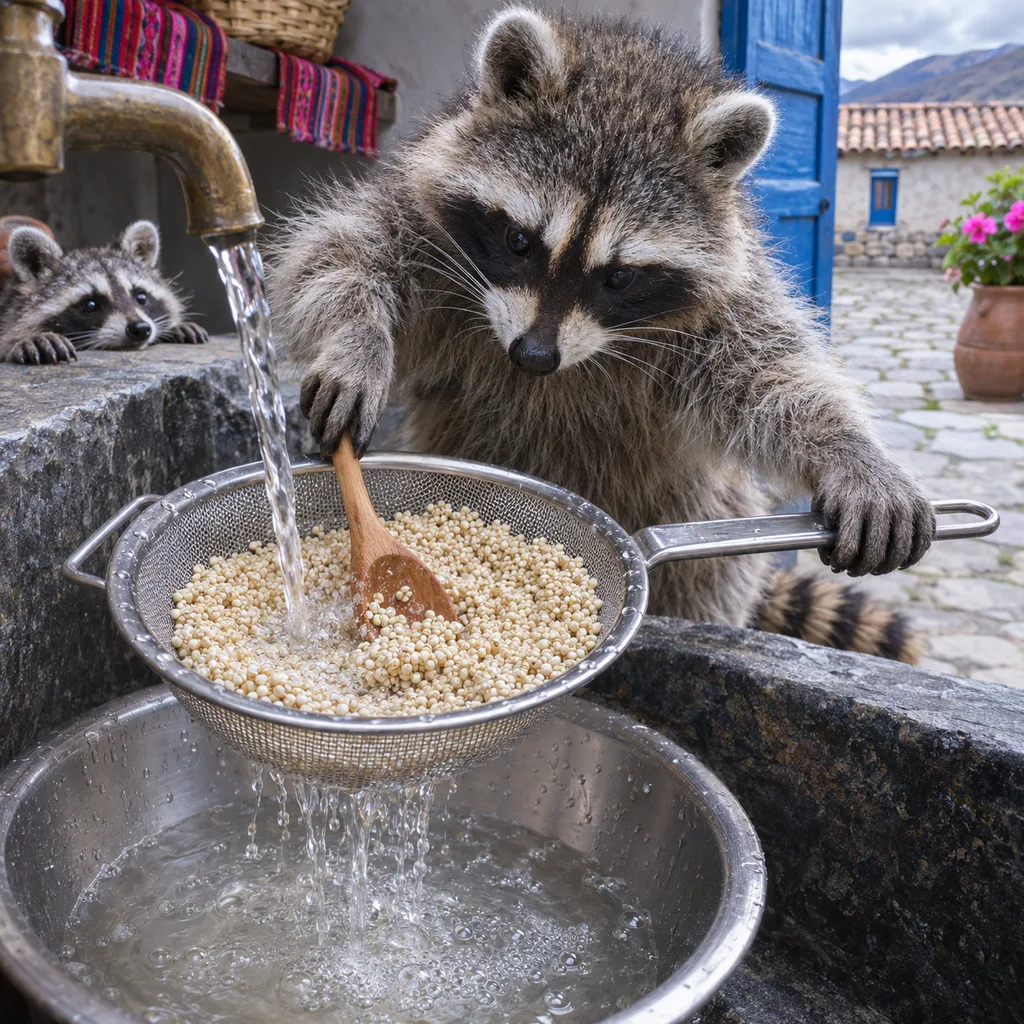
Put the 160 g dry quinoa in the fine-mesh sieve. Rinse under cold running water for 60–90 seconds, stirring gently with a spoon so water reaches all the grains. Let it drain while you prepare the vegetables. The sieve must be fine enough to retain the small seeds.
2. Soften the vegetables
Heat the 20 ml oil in the saucepan over medium heat. Add the onion and carrot and cook for 7–8 minutes, stirring frequently, until the onion is soft and translucent. Keep it from catching or turning dark; lower the heat if the edges brown before the centre softens. The carrot will finish cooking in the soup.
3. Cook the tomato base
Add the garlic and stir for 1 minute. Add the tomatoes and cook for 5–6 minutes, crushing them with the spoon, until they soften into a loose, pulpy sauce and there is no raw garlic smell. Scrape the base as you stir so nothing scorches.
4. Simmer the quinoa and potatoes
Add the drained quinoa, potato cubes, 1.4 litres water, oregano and 4 g salt. Bring to a boil over medium-high heat, then reduce to a gentle simmer. Set the lid slightly ajar and cook for 18 minutes, stirring across the bottom every few minutes. Keep the vegetables submerged; if the level drops sharply, reduce the heat and add boiling water in 50 ml portions.
5. Add the peas and check doneness
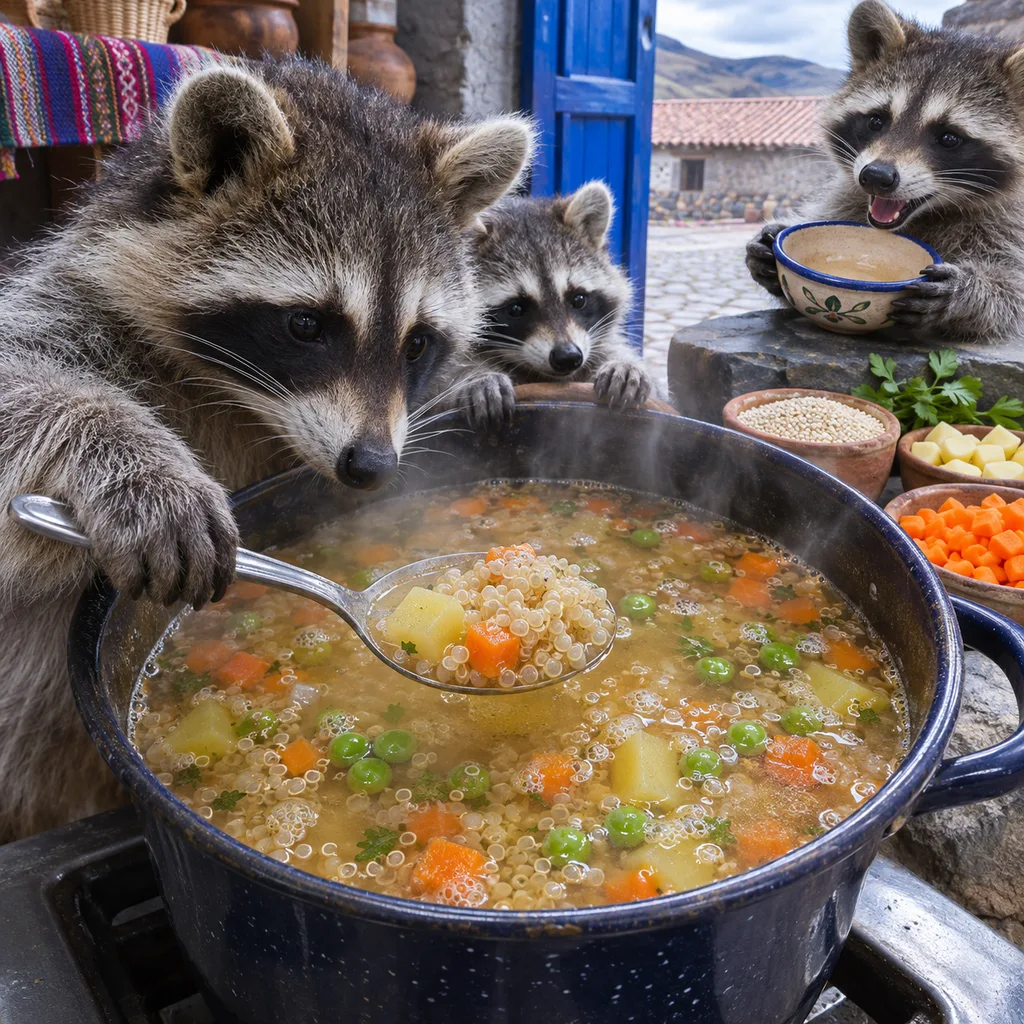
Stir in the frozen peas and simmer for another 5 minutes. The quinoa should be translucent with visible curled white germs and no hard, chalky centre. A knife should pass easily through a potato cube and the carrot should be tender. If either the quinoa or potato is still firm, simmer for another 3–5 minutes and check again, adding a little boiling water if needed. The broth should flow freely between the grains and vegetables.
6. Rest and serve
Stir in the black pepper. Turn off the heat, cover fully and leave for 5 minutes. Stir again before dividing the soup evenly between four bowls so each gets a similar share of grain and vegetables. Taste before adding any further salt. If it has thickened beyond a brothy soup, stir in boiling water 50 ml at a time to loosen it.
Measured variations
Make either change to the full four-serving base. Keep every unmentioned ingredient and quantity the same. The nutrition estimate covers the base above, excluding both variations and any further seasoning.
Pumpkin instead of potato
Replace all 300 g peeled potato with 300 g peeled, seeded pumpkin, cut into 2 cm cubes. Keep the 1.4 litres water. In step 4, start the quinoa without the pumpkin and simmer for 10 minutes. Add the pumpkin, simmer for 8 minutes, then add the peas and continue for 5 minutes as in step 5. Check that the pumpkin is easily pierced but still holds its shape; allow another 3–5 minutes for a firm variety. Keep the final 5-minute rest. The overall timing stays about 1 hour 5 minutes, with extra simmering if needed. This version has a softer, sweeter vegetable component and a less starchy broth.
Milk and fresh cheese
Reduce the starting water to 1.25 litres and the salt to 2 g. Cook the quinoa, potatoes and peas through as written. Before the off-heat rest, turn the heat low, stir in 150 ml whole milk and heat gently for 2–3 minutes until steaming. Avoid a rolling boil. Turn off the heat and fold in 120 g pasteurized queso fresco, cut into 1 cm cubes, then cover and rest for 5 minutes. The cheese should soften rather than disappear into a smooth sauce. Taste before adding more salt because cheese salinity varies. Allow about 1 hour 10 minutes in total. This is this page's dairy variation, with the same four-serving yield; it is not labelled as a universal traditional preparation.
Texture and leftovers
If the grains are tender but the soup is too thick, add hot water in small portions and check the seasoning again. If the liquid is thin, mash a few cooked potato cubes against the saucepan wall and stir them back in. Do this after the quinoa is tender rather than boiling aggressively to force it to thicken. Bitter soup usually points to the quinoa or scorched aromatics; extra salt will not repair burnt garlic.
Quinoa continues absorbing liquid in storage. Divide leftovers into shallow containers and refrigerate within 2 hours, or within 1 hour if the room is hotter than 32°C. Keep at 4°C or colder and use within 3 days. These limits follow USDA leftover-handling guidance; do not leave the full pot on the counter to cool overnight. Reheat only the portion needed in a saucepan, adding 50–100 ml water per bowl as needed. Stir and heat throughout to 74°C, following USDA reheating guidance.
More from the region
Read the Peru cuisine notes for the broader regional collection. Peruvian causa limeña uses potatoes in a chilled layered dish, while tiradito Nikkei takes a different approach to a cold first course. For a separate corn-and-pumpkin preparation from northwestern Argentina, try humita en chala; its husk wrapping and steaming method are distinct from this soup.
Estimated nutrition per serving
One serving is 1/4 of the recipe. Values are rounded estimates.
- Calories
- 310 kcal
- Protein
- 10 g
- Carbohydrate
- 52 g
- Fat
- 7 g
Calculated from USDA FoodData Central, SR Legacy (April 2018) food composition data and the stated recipe yield.
How this estimate was calculated
Ingredient amounts are converted to edible weights, matched to USDA foods, added together and divided by 4 servings. Comparable foods are used where a regional ingredient has no exact record. Ingredient brands, portion sizes, discarded fat and cooking losses can change the result. Optional ingredients and unmeasured accompaniments are excluded. Sodium is not estimated because salt and brine retention vary.
- Base vegetable soup only, divided into four equal servings. Pumpkin and milk/cheese variations, extra salt and unmeasured accompaniments are excluded.
- Dry quinoa uses the verified USDA raw quinoa record at 160 g before rinsing. Rinsing loss is assumed negligible; all cooked grains, vegetables and soup liquid are consumed.
- Potato with skin is the available USDA proxy for the stated peeled potato weight; raw green peas proxy the measured frozen plain peas. Vegetable variety and freezing change composition.
- All 20 ml olive oil is retained and counted as 18.2 g using 0.91 g/ml. Water and salt add no counted energy or macronutrients; evaporation changes final volume, not the ingredient totals.