Humita en Chala
Fresh corn becomes a thick, spoonable filling before it goes into the husks. A little pumpkin adds body and colour, and a piece of cheese softens in the centre as each parcel steams. Open the wrapping on the plate so the filling stays warm while you eat.
Tucumán's official humita recipe describes the regional combination of corn, pumpkin and cheese, served either in a pot or inside corn husks. This home-kitchen adaptation uses a smaller measured batch, olive oil and mozzarella in place of the source's beef fat and queso cremoso. The steaming approach also draws on Felicitas Pizarro's humita en chala. It is one version of the dish, with practical substitutions stated here rather than presented as a single formula for every household.
Makes eight parcels, serving four as a main course. Allow about 2 hours 10 minutes, including a 20-minute husk soak that overlaps corn preparation, a 10-minute cooling stage and 5 minutes of resting after steaming. Corn moisture and the width of the cooking pan can add 10–15 minutes of reduction. For a smaller side portion, serve one parcel per person.
Equipment and corn choice
You need a box grater, wide bowl, heavy 26–28 cm saucepan or sauté pan, flexible spatula and a large lidded steamer that holds eight parcels without crushing them. Have a heatproof plate, tongs and kitchen string available. Keep the steamer insert above the water; the parcels cook in steam rather than floating in it.
Buy fresh corn with intact husks. About eight large ears usually provide enough broad leaves and grated pulp, but ear size varies. Weigh the usable corn, not the cobs or husks, and reserve any excess for another meal. Look for at least sixteen broad, undamaged inner leaves, each roughly 20 cm long and 12–15 cm wide. Small or torn leaves will not hold this quantity of filling.
This recipe relies on the moisture and texture of fresh grated corn. Masa harina, canned kernels and dried cornmeal would require different hydration and cooking instructions. For a separate preparation using masa harina, see homemade corn tortillas.
Ingredients
Wrapping
- 🌽 16 large fresh corn husks, plus 4 spare leaves and 8 narrow husk strips
Filling
- 🌽 800 g fresh corn pulp and kernels, coarsely grated from the cobs
- 🎃 250 g pumpkin, peeled, seeded and finely grated
- 🧅 200 g onion, peeled and finely diced
- 🌶️ 100 g red sweet pepper, stemmed, seeded and finely diced
- 🫒 30 ml olive oil
- 🥛 100 ml whole milk
- 🧀 160 g whole-milk mozzarella, cut into 8 pieces
- 🌶️ 4 g sweet paprika
- 🧂 5 g fine salt
- 🌿 6 g fresh basil leaves, finely sliced
Use pasteurized milk and mozzarella. A low-moisture mozzarella makes the filling easier to control than a wet ball packed in liquid. The cheese is a stated substitute for a soft Argentine cheese, not a claim that every local version uses mozzarella. The recipe contains milk.
Instructions
1. Soften the husks and grate the corn
Remove the silk and discard damaged or mouldy leaves. Rinse the selected husks and strips under running water, then soak them in a wide bowl of hot tap water for 20 minutes, weighing them down with a plate. Drain and pat them dry before wrapping.
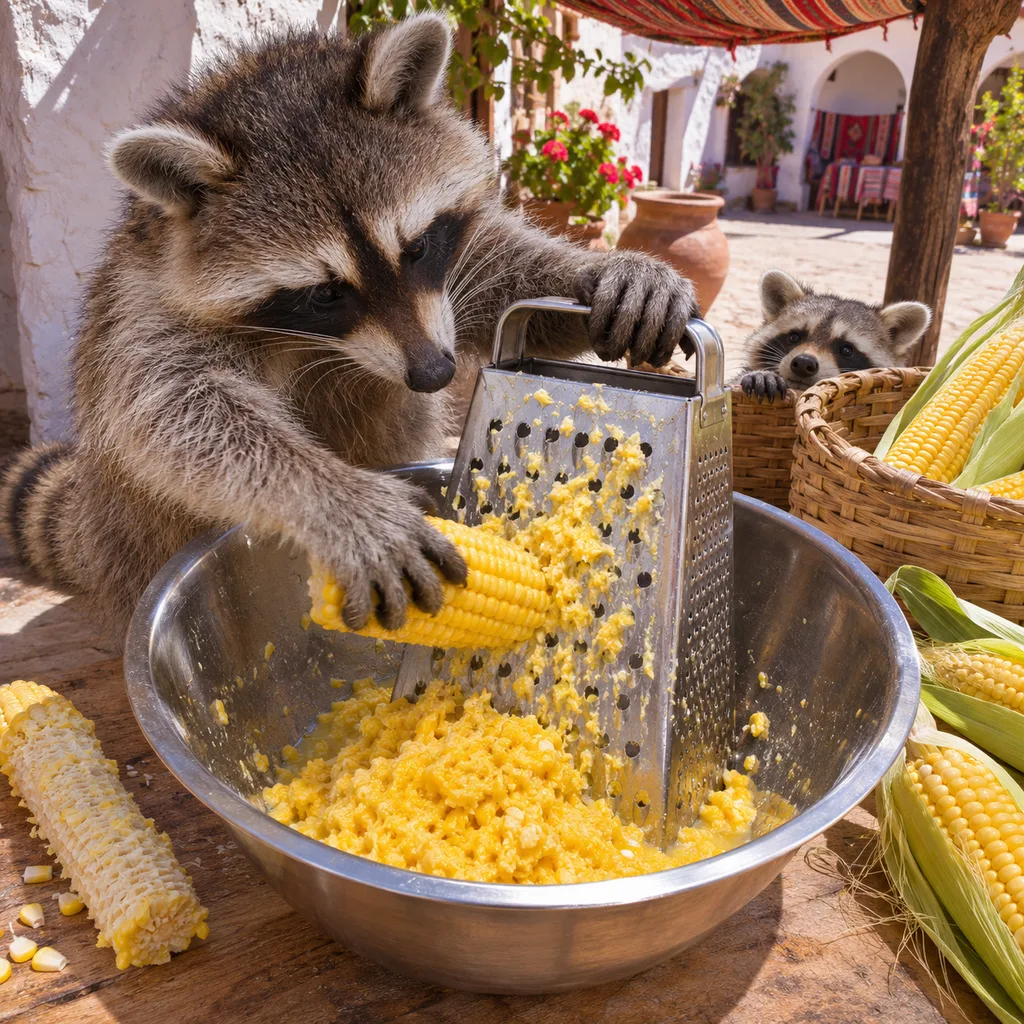
While they soak, stand the box grater in a wide bowl and grate the corn across its coarse face. Work along each cob, turning it to expose the remaining kernels. Stop before your fingers approach the sharp face and scrape the soft corn left on the cob with a spoon. Keep all the milky juice collected in the bowl. Weigh 800 g of pulp and kernels, then grate the pumpkin and dice the onion and pepper.
2. Soften the onion and pepper
Heat the olive oil in the heavy pan over medium heat. Add the onion and red pepper and cook for 8–10 minutes, stirring often, until the onion is translucent and both vegetables soften without darkening. Lower the heat if the small pieces catch at the edges. Stir in the paprika for 20–30 seconds, just until fragrant.
3. Cook the corn filling until thick
Add the grated corn with its juice, the pumpkin, milk and salt. Stir well and bring to a gentle bubbling simmer. Reduce the heat to low and cook for 30–40 minutes, scraping the base and corners frequently. Stir almost continuously once the mixture thickens; corn catches easily.
The pumpkin should lose its raw firmness and the corn should taste cooked rather than chalky. Drag the spatula through the centre: the channel should stay open briefly before slowly closing. A spoonful should form a soft mound with no watery ring. If the mixture flows like soup, continue uncovered in 5-minute intervals. If it sticks before the corn softens, lower the heat and add 15 ml water at a time, allowing each addition to cook into the filling. Stir in the basil at the end.
4. Cool and portion the filling
Spread the cooked filling on a large heatproof plate or shallow tray and leave for about 10 minutes, until it is warm enough to handle comfortably. Do not leave it cooling for hours. Divide it into eight equal portions; weighing the finished filling makes this easier. Cut the mozzarella into eight equal 20 g pieces. During this stage, set up the steamer and start heating its water.
5. Fold and tie eight parcels
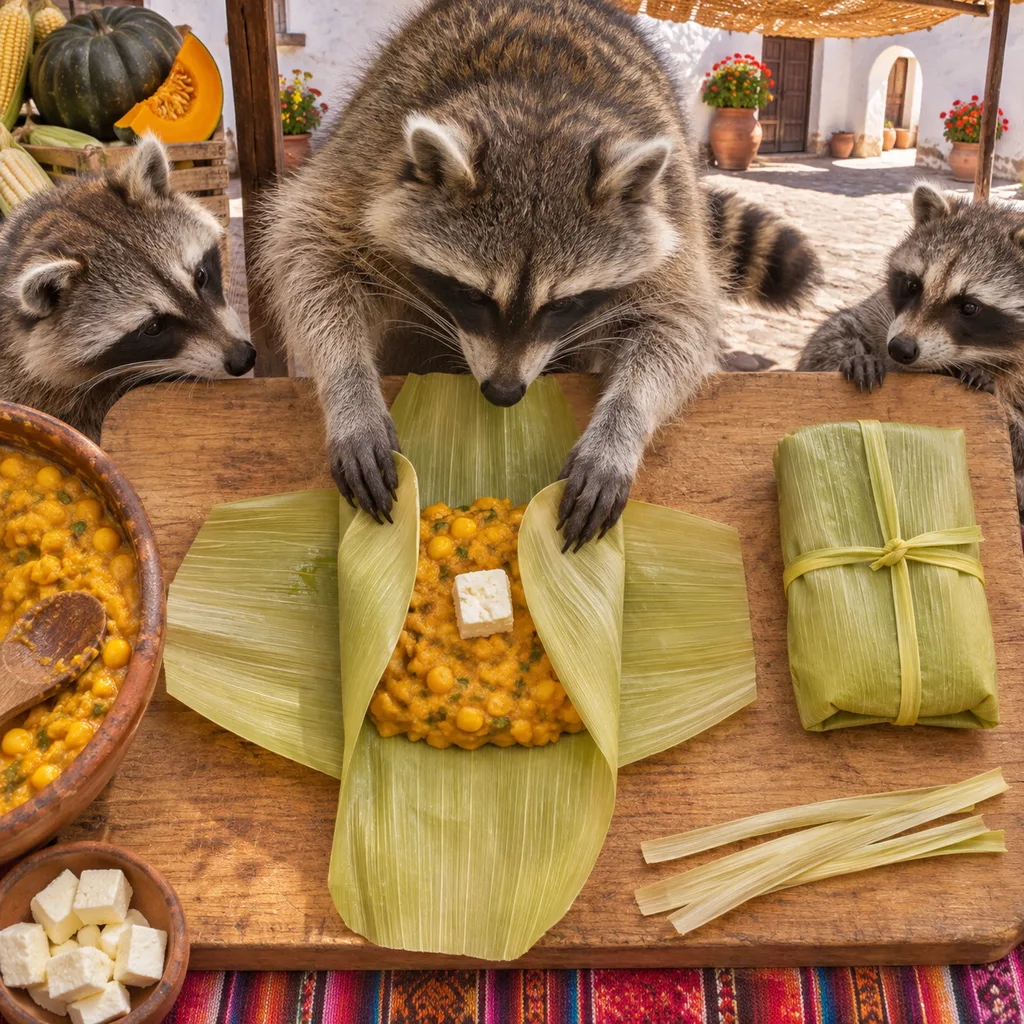
Lay one drained husk across a second to form a cross, with their broad centres overlapping. Put half of one filling portion in the centre, add a cheese piece, then cover it with the rest of that portion. Shape the mound roughly 8 cm by 6 cm and keep the projecting husk flaps clear. The flaps must overlap by at least 2 cm when folded; use larger leaves if they only meet edge to edge.
Fold the left and right flaps over the filling, then fold the top and bottom flaps over those to make a closed rectangular package. Tie gently in both directions with a narrow husk strip or kitchen string. Keep the knot secure without squeezing filling through the seams. If a leaf tears, cover the split with a spare leaf before tying. Repeat to make eight parcels.
6. Steam, rest and open carefully
Bring the steamer water to a steady simmer. Arrange the parcels seam-side up on the insert in a loose single layer, or in two loosely staggered layers with gaps for steam. Keep the water at least 2 cm below the parcels. Cover tightly and steam for 25–30 minutes. Check the water halfway through and add boiling water down the side if needed; do not pour it over the parcels or let the pan boil dry.
Use tongs to open one parcel on a plate. Its filling should be thoroughly hot, its cheese softened through and its husks pliable. If the centre is only warm, close it again and steam the batch for another 5 minutes. Remove the parcels to a platter and rest for 5 minutes. Cut the ties and open the husks away from your face, letting the trapped steam escape. Eat the filling and discard the husks and ties.
When the parcels leak
A little moisture on the husk is expected; a stream of filling usually means it was too loose or the leaf did not overlap enough. Cook the next portion thicker, use larger husks and keep the clear border around the filling. Do not add dry flour to an already cooked batch by guesswork. If the available husks cannot enclose the portions, serve the fully cooked corn filling in bowls with the cheese stirred through, rather than making parcels that will spill in the steamer.
The filling should be tender and creamy, with small corn pieces still visible. It is not a firm kneaded dough. Letting the parcels stand for a few minutes helps each serving hold together without making the corn dry.
Serve and store
Serve two parcels as a main course, or one as a smaller accompaniment to Argentine asado. The Argentina food guide places humita alongside other regional dishes. The Buenos Aires empanada guide explains another way corn appears in a filling: a corn empanada has a pastry shell, while this recipe uses the husk as its wrapper.
Refrigerate leftover parcels promptly in shallow containers at 4°C or below, within 2 hours of cooking, or within 1 hour when the surroundings exceed 32°C. Reheat the portion needed in a covered steamer until the centre reaches 74°C, checking through the opened husk with a food thermometer. The FDA's food-handling guidance explains prompt cooling and the reheating endpoint. Cook only the quantity you can serve or chill promptly; do not leave the tied parcels in a cooling steamer overnight.
Estimated nutrition per serving
One serving is 1/4 of the recipe. Values are rounded estimates.
- Calories
- 415 kcal
- Protein
- 18 g
- Carbohydrate
- 50 g
- Fat
- 20 g
Calculated from USDA FoodData Central, SR Legacy (April 2018) food composition data and the stated recipe yield.
How this estimate was calculated
Ingredient amounts are converted to edible weights, matched to USDA foods, added together and divided by 4 servings. Comparable foods are used where a regional ingredient has no exact record. Ingredient brands, portion sizes, discarded fat and cooking losses can change the result. Optional ingredients and unmeasured accompaniments are excluded. Sodium is not estimated because salt and brine retention vary.
- One serving is two of eight parcels; edible filling only. Corn and pumpkin use raw edible weights; husks, cobs and ties are not food.
- Counts the full measured oil, milk, mozzarella and cooked filling. Evaporation changes parcel weight but does not remove the counted energy.
- Whole-milk mozzarella is the available USDA proxy for the specified low-moisture whole-milk cheese; moisture and brand composition vary.
- Olive oil is counted at 27.3 g per 30 ml and milk at 103 g per 100 ml; salt contributes no counted energy or macronutrients.