Kashk-e Bademjan
Golden aubergine, slow-cooked onion and tangy kashk make a soft spread with enough texture to scoop onto bread. A brief warming in oil opens up the dried mint; keeping it away from fierce heat prevents a bitter finish.
Kashk-e bademjan belongs to the varied cooking of Iran. Visit Iran's account describes aubergine and kashk as its core, with fried onion, garlic and dried mint, and notes regional additions including walnuts. This version uses peeled, pan-browned aubergine and a modest walnut topping. Homa's Persian Mama method informs the browning, covered softening and coarse mash; her published version finishes with yogurt, while this one uses commercial kashk.
Yield: Four generous appetizer portions, roughly 200–250 g each depending on evaporation, or two larger portions with bread. Bread is additional.
Timing: Allow about 1 hour 45 minutes, including 20 minutes of salting and 5 minutes before serving. Cook the onions and prepare the kashk while the aubergine browns. The estimate allows for three frying batches and, where the package requires it, up to 20 minutes of separate kashk boiling during the other work. A smaller pan or a longer label-required heating period adds time.
Ingredients
Aubergine and onions
- 🍆 900 g aubergine, weighed after peeling and trimming
- 🧂 4 g fine salt, for salting the aubergine
- 🫒 90 ml olive oil, divided
- 🧅 300 g onions, peeled and thinly sliced
- 🧄 4 garlic cloves, about 12 g, peeled and minced
- 🟡 ½ tsp ground turmeric, about 1.5 g
- 🌶️ ¼ tsp ground black pepper
- 💧 150 ml water, plus more as needed
Kashk and topping
- 🥛 150 g commercial pasteurized liquid kashk
- 💧 60 ml water, for thinning the kashk
- 🌿 2 tsp dried mint, about 2 g
- 🌰 30 g walnut kernels, roughly chopped
- 🧂 Fine salt, to taste
Buy about 1.1 kg whole aubergines to obtain the 900 g prepared weight; the loss varies with shape and peeling. Slender Italian aubergines or medium globe aubergines work. Cut large ones into shorter planks so they fit the pan. The oil allocation is 60 ml for aubergine, 20 ml for onions and 10 ml for mint; there is no deep-frying bath.
Choosing and handling kashk
Use a sealed commercial liquid kashk explicitly labeled pasteurized, with readable storage and preparation directions. It is a concentrated, sour dairy ingredient, often sold as Persian whey. For example, Sadaf lists cultured pasteurized whole milk, water, salt and whey for its liquid product. It is different from plain liquid whey drained from cheesemaking, and from grain-based kishk.
Follow the specific package's heating directions before adding kashk to the dish or using it as a garnish. Some products require boiling before use; pasteurization is not a reason to skip instructions on the jar. Ramak's own guidance recommends packaged pasteurized kashk and refrigerated storage. This recipe does not use homemade fermented kashk or loose, unlabelled curd. Keep the opened container refrigerated and observe its stated use-by period.
The 60 ml water makes thick liquid kashk pourable. Brands differ: add it gradually, stopping when the mixture falls from a spoon in a thick ribbon. Keep any remaining water for cooking adjustments. Plain Greek yogurt can make a different aubergine dip, but it does not reproduce kashk's concentrated flavor and is outside this recipe's quantities and estimate.
Instructions
1. Salt and dry the aubergine
Cut the peeled aubergine into planks about 1.5 cm thick. Toss with the 4 g salt in a colander and leave for 20 minutes. Blot firmly with clean kitchen paper or a cloth, including the cut edges. Do not rinse unless it tastes excessively salty; if you rinse, dry it especially well. Salting here helps draw off surface moisture before browning.
2. Prepare the kashk
While the aubergine stands, read the kashk label and carry out its required preparation in a small saucepan. Stir in water from the measured 60 ml as needed to prevent scorching. If the label requires a timed boil, begin timing once the mixture boils and maintain it for the full stated period, stirring and adding small splashes of water if it thickens. Do not replace this with a brief warming in the finished dip.
Once prepared, reserve about one-fifth of the mixture for the topping and keep both portions covered while finishing the recipe. The topping must receive the same label-required heating as the rest.
3. Brown the onions
Warm 20 ml oil in a medium frying pan over medium-low heat. Add the sliced onions and cook for 20–25 minutes, stirring frequently, until soft and golden with a few deeper brown edges. Lower the heat if they darken before softening. Reserve one-third of the cooked onions for serving.
Add the garlic, turmeric and black pepper to the remaining onions. Stir over low heat for 45–60 seconds, just until fragrant, then remove the pan from the heat. The garlic should not turn dark brown.
4. Brown the aubergine in batches
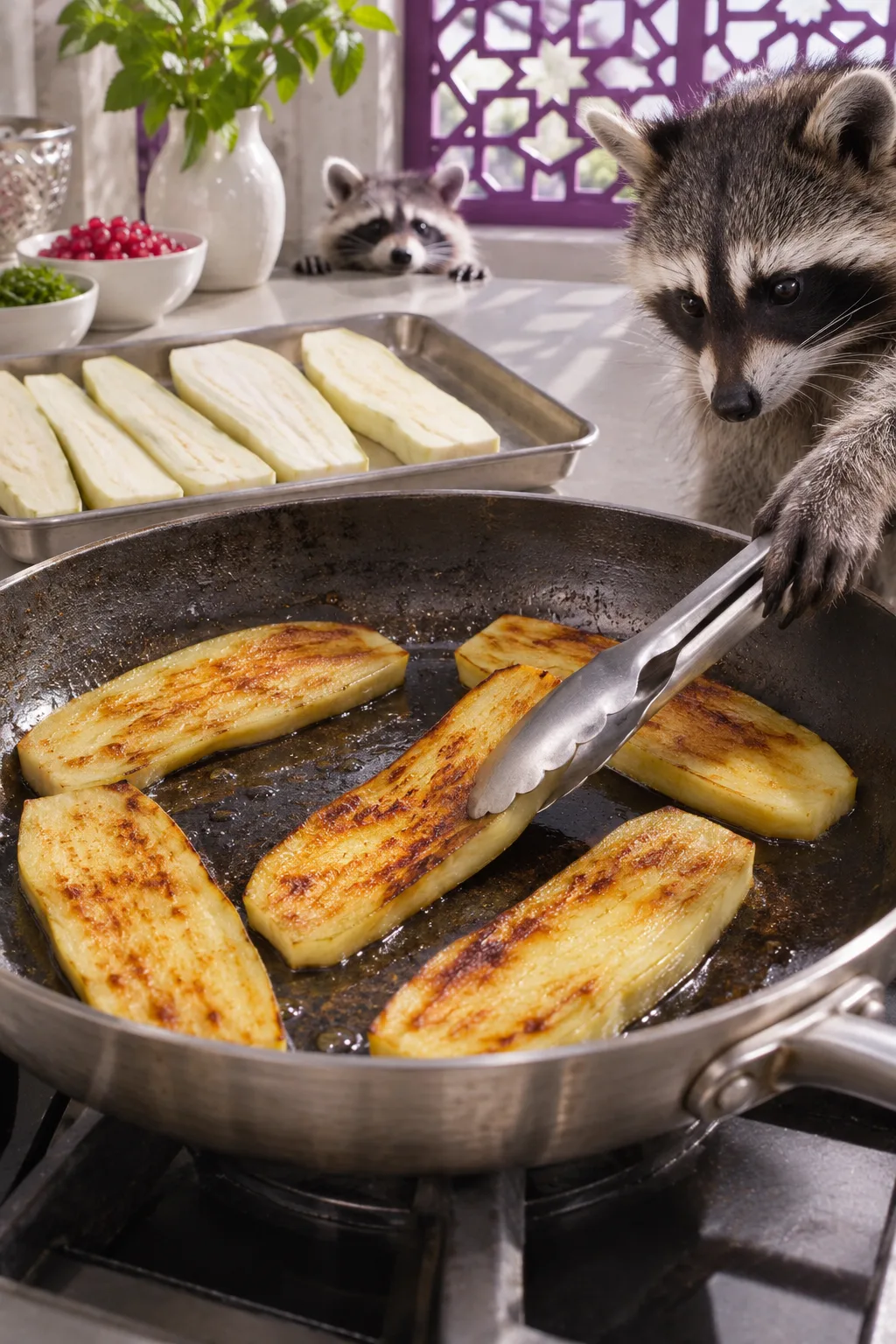
Heat a wide, heavy nonstick or well-seasoned frying pan, about 28 cm across, over medium heat. Use 20 ml oil for each of three batches. Lay the dry planks in one layer with a little space between them and cook for about 4–5 minutes per side, until both faces are golden brown and the flesh has started to soften. Transfer each batch to a plate. Adjust the heat to keep the oil shimmering without smoke; do not pour in more oil whenever the raw aubergine first absorbs it.
5. Steam until soft and mash
Return all the aubergine to the wide pan. Add the garlic-onion mixture and 150 ml water, bring to a gentle simmer, then cover and cook over low heat for 12–15 minutes. A fork should slide through the thickest piece without resistance. If the pan dries before the flesh softens, add water 30 ml at a time and continue covered.
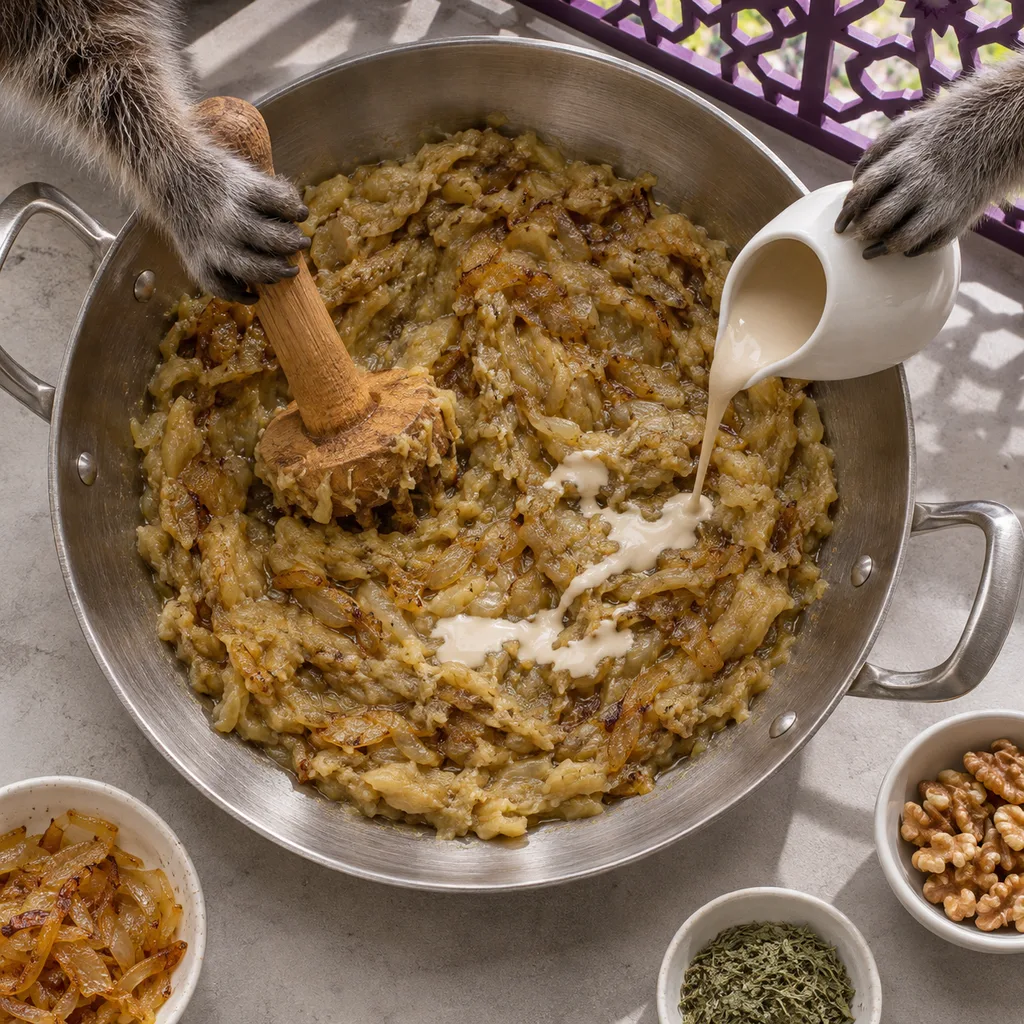
Uncover and mash with a fork or potato masher into a coarse, fibrous spread. Cook uncovered for 2–4 minutes, stirring, if there is free water around the edges. Leave small soft pieces rather than processing it into a smooth purée.
6. Stir in the kashk
Lower the heat and stir in the larger portion of prepared kashk. Cook gently for 3–5 minutes, stirring until evenly combined and hot throughout. The spread should mound softly on a spoon, with no puddle underneath. Add water a tablespoon at a time if it becomes stiff. Taste before adding any final salt, because kashk's saltiness varies considerably.
7. Warm the mint and finish
In a small pan, toast the walnuts over medium-low heat for 2–3 minutes, shaking frequently, until fragrant; tip them onto a plate. Add the remaining 10 ml oil to the empty pan and warm over low heat. Remove from the burner, add the dried mint and stir for 10–15 seconds. It should smell fragrant and retain a green-brown color. Discard and remake it if it turns black or smells burnt.
Spoon the aubergine onto a shallow serving plate and let it stand for 5 minutes. Swirl over the reserved prepared kashk, loosening it with a teaspoon of water if necessary. Add the reserved golden onions, mint oil and toasted walnuts. Serve warm with lavash, sangak or another flatbread.
Texture and serving notes
Watery spread: Reduce the aubergine before adding kashk, stirring so the base does not catch. After adding kashk, use gentle heat and patience rather than a fierce boil.
Aubergine still springy: Brown color is only the first stage. Return the lid with a little water and keep cooking until the flesh collapses under a fork.
Too salty: Check before salting the finished dish. Extra water only thins the dip; it does not remove salt. To correct a seriously salty batch, fold in additional fully cooked unsalted aubergine and accept the larger yield.
Serve a small portion as part of a shared meal with fesenjan or ghormeh sabzi, rather than treating it as another stew. Iranian jeweled rice can be cooked separately for a larger table. For a different aubergine spread, baba ganoush uses charred flesh, tahini and lemon.
Storage
Transfer leftovers to shallow containers and refrigerate promptly at 4°C or below, within 2 hours of cooking, or within 1 hour above 32°C. Use within 3 days, or sooner if the kashk label requires it. Keep extra topping separate if convenient. These limits follow USDA guidance on cooling and storing leftovers, using the shorter end of its storage range.
Reheat only the portion needed, covered over low heat with a splash of water, stirring frequently. Check several spots reach 74°C before serving, following USDA's reheating guidance.
Estimated nutrition per serving
One serving is 1/4 of the recipe. Values are rounded estimates.
- Calories
- 370 kcal
- Protein
- 7 g
- Carbohydrate
- 24 g
- Fat
- 29 g
Calculated from USDA FoodData Central, SR Legacy (April 2018) food composition data and the stated recipe yield.
How this estimate was calculated
Ingredient amounts are converted to edible weights, matched to USDA foods, added together and divided by 4 servings. Comparable foods are used where a regional ingredient has no exact record. Ingredient brands, portion sizes, discarded fat and cooking losses can change the result. Optional ingredients and unmeasured accompaniments are excluded. Sodium is not estimated because salt and brine retention vary.
- Uses 900 g peeled and trimmed raw aubergine; the 1.1 kg shopping weight includes discarded peel and stems.
- Counts all 90 ml olive oil as retained (82.17 g at 0.913 g/ml), including aubergine, onion and mint oil. Actual pan residue may lower intake.
- Commercial liquid kashk varies. In the absence of a catalogue kashk record, its 150 g is approximated by 100 g whole-milk plain yogurt plus 50 g feta for a more concentrated cultured-dairy proxy. This is a nutrition calculation, not a recipe substitution; low-fat brands can differ materially.
- Uses 8 g fresh spearmint as the nutrient proxy for 2 g dried mint, assuming fourfold concentration on drying. Counts 12 g edible garlic and 0.575 g black pepper.
- Includes the measured walnuts and all kashk topping; excludes bread, salt and water. No sodium estimate is inferred.