Fesenjan
Finely ground walnuts give fesenjan its body. As the stew simmers gently, the sauce becomes darker and thicker, with small beads of walnut oil at the surface. Pomegranate molasses provides the sour-fruit edge; its concentration and added sugar determine how much balancing the pot needs.
Fesenjan, also called fesenjoon, is an Iranian khoresh served with rice. This chicken version draws on the walnut-and-pomegranate methods published by Homa at Persian Mama and Omid Roustaei at The Caspian Chef. It uses boneless thighs and a larger measured water allowance for a manageable home-stove simmer. It is one adaptation, rather than a claim that every household makes the same stew. The Iran food guide gives wider context.
Yield: four main-course portions of stew, with rice served separately. Allow about 2 hours 15 minutes, including a 10-minute rest. Most of the cooking is a gentle simmer, but stir regularly: the walnut solids can catch on the bottom. A very watery pot may need another 10 to 20 minutes of reduction; two browning batches add about 10 minutes. Cook the rice during the final half-hour, using its own recipe timings.
Equipment
Use a food processor, a 24 cm heavy casserole or deep sauté pan with a lid, a flat-edged wooden spatula and an instant-read thermometer. A thin saucepan makes the thick sauce harder to heat evenly.
Ingredients
Stew
- 🍗 800 g boneless, skinless chicken thighs, left whole
- 🌰 200 g shelled walnut halves
- 🧅 200 g onion, peeled and finely diced
- 🫒 15 ml olive oil
- 🍎 100 g pomegranate molasses
- 💧 550 ml water
- 🧂 3 g fine salt
- 🌶️ 0.5 g ground black pepper
Optional balance and serving
- 🍬 10 g granulated sugar, optional
- 🍚 Plain cooked basmati rice, for serving
Choose pomegranate molasses made from concentrated pomegranate juice, rather than a cocktail syrup or sugarcane molasses. Some bottles are sharp and others noticeably sweet. Taste a tiny amount before cooking, then use the measured 100 g as the starting amount. The optional sugar is divided into small additions in the method. Rice is an accompaniment and is not included in the stew's nutrition estimate.
Check the walnuts for pieces of shell and taste one before grinding. Stale or rancid nuts stay unpleasant after a long simmer; pomegranate and sugar cannot repair them. This recipe contains walnuts.
Instructions
1. Grind the walnuts finely
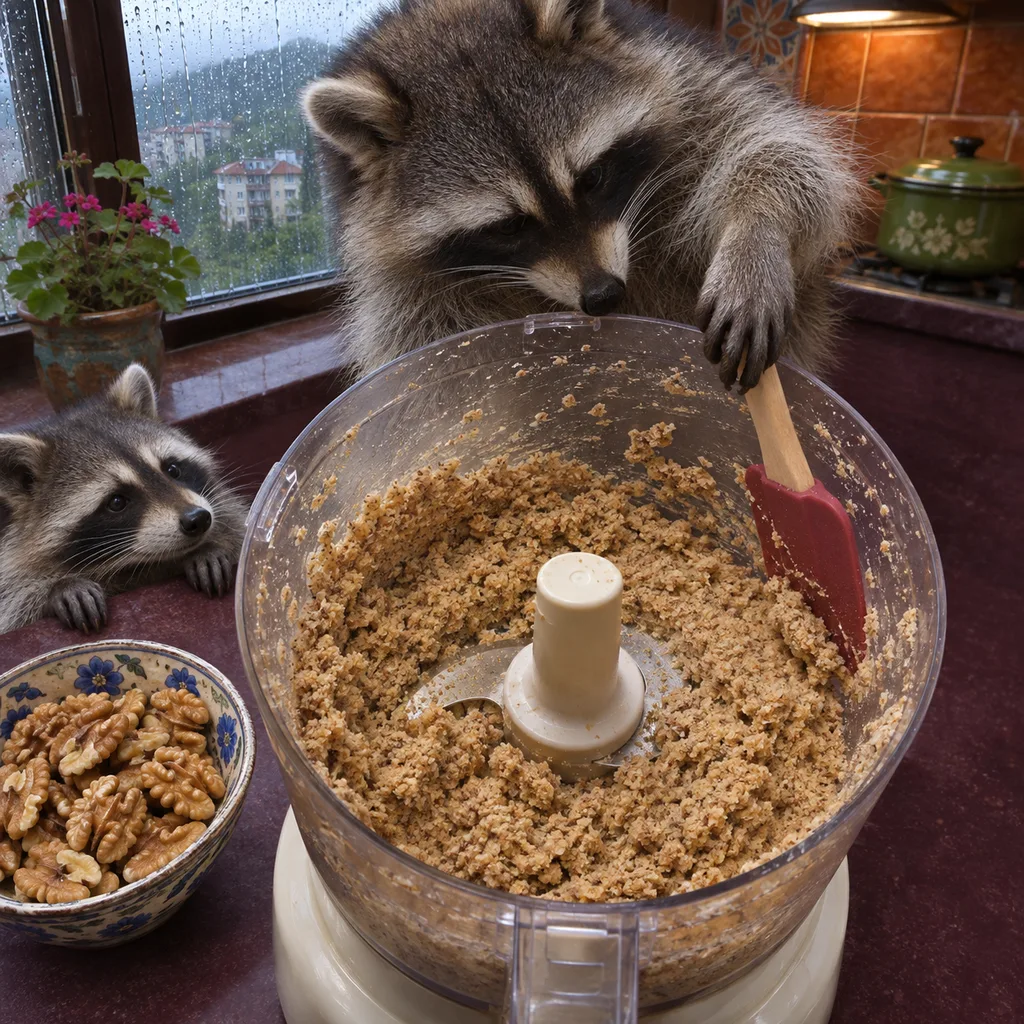
Put the walnut halves in the food processor and pulse to a fine, evenly sized meal, stopping to scrape down the bowl with the machine switched off. A few damp clumps are fine. Stop before the nuts become a freely flowing nut butter. Rub a pinch between your fingers: there should be no large hard pieces. Dice the onion and measure the other ingredients before handling the chicken.
2. Lightly brown the chicken
Pat the chicken dry with kitchen paper; do not rinse it. Heat the olive oil in the casserole over medium heat. Add the thighs in a single layer and cook for about 4 to 5 minutes on each side, until lightly golden. Work in two batches if the pieces overlap. Transfer them to a clean holding plate. They will still be raw inside and must return to the pot for thorough cooking.
3. Soften the onion and add walnuts
Lower the heat to medium-low. Add the diced onion to the oil remaining in the pot and cook for about 8 to 10 minutes, stirring, until soft and lightly golden. Add 15 ml from the measured water if the onion begins sticking. Stir in the ground walnuts and cook for 2 minutes, scraping the bottom continuously. They should smell nutty without developing dark toasted flecks.
4. Build a gentle simmer
Stir in the pomegranate molasses, remaining measured water, salt and pepper. Scrape up the browned chicken residue, then return the thighs and all their juices. Bring to a gentle simmer over medium heat, about 3 to 5 minutes. Turn the heat to low and partly cover the pot. Aim for occasional small bubbles, not a rolling boil.
Simmer for about 70 to 80 minutes, stirring and scraping the bottom every 10 minutes. Turn the thighs carefully halfway through. If the sauce becomes pasty before the chicken is tender, add hot water in 30 ml amounts to loosen it. The thighs should reach at least 74°C (165°F) at their thickest point and become easy to separate with a fork. Check several pieces rather than judging their colour.
5. Balance and thicken the sauce
Taste a small spoonful after the chicken is cooked through. If it is too sharp for you, dissolve 5 g of the optional sugar in the sauce, simmer for 2 minutes and taste again. Add the remaining 5 g only if needed. If it tastes too sweet, do not keep adding sugar; a sharper molasses is a better choice for the next pot. Serve this batch with plain rice to soften the contrast.
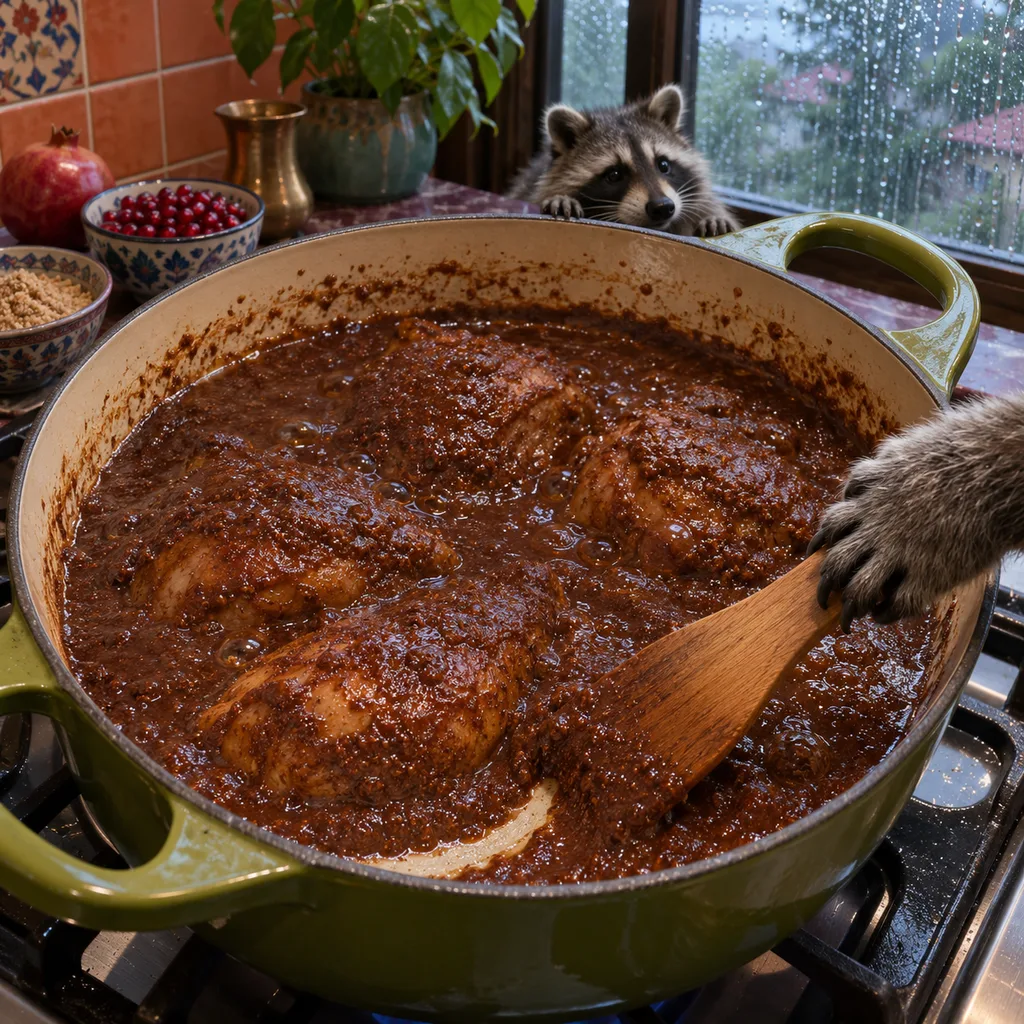
Remove the lid and simmer gently for about 5 to 10 minutes, stirring often, until the sauce coats the chicken and a spatula drawn across the base leaves a track that closes slowly. If the chicken is already very tender and the sauce needs longer, lift the thighs out while reducing it, then return them to heat through. A few beads of oil at the edge are expected; do not force a heavy oil layer by boiling hard.
6. Rest and serve
Turn off the heat, cover and rest for 10 minutes. Stir gently, divide into four portions and serve with plain rice. The sauce thickens as it stands; loosen it with 15 to 30 ml hot water if needed before plating. Keep the chicken pieces intact rather than shredding them through the sauce.
Adjust the next pot
Sauce tastes bitter: burnt walnut solids or rancid nuts may be responsible. Do not scrape a scorched base into the stew. Transfer the unburnt upper layer to a clean pot without disturbing the bottom, then assess it; a burnt flavour throughout is not something to cover with extra sugar.
Sauce stays pale or grainy: check that the nuts were ground finely and give the pot more gentle cooking time. Colour depends on the molasses as well as the simmer, so use a thick, cohesive sauce and tender chicken as the practical endpoints rather than chasing an almost-black colour.
Sauce turns too thick: add hot water in small measured amounts and stir over low heat. More oil is not needed to make the sauce move. A violent boil increases sticking and breaks up tender chicken.
A sweeter or sharper version: change the final balance in small amounts and note the molasses brand. The two source recipes above explain their own approaches; the same volume of every commercial syrup will not give an identical result.
Store and reheat
Keep raw chicken and its utensils separate from ready-to-eat foods. The chicken endpoint of 74°C (165°F), prompt refrigeration and reheating guidance follow the FDA's safe food handling advice.
Divide leftovers into shallow containers and refrigerate within 2 hours, or within 1 hour if the room is above 32°C (90°F). Reheat the portion you need to 74°C (165°F), stirring frequently and adding a little water so the walnut sauce does not catch. Do not cool the entire heavy casserole slowly on the counter.
For a more elaborate rice accompaniment, plan the separate timing of Iranian jeweled rice. For another Iranian stew with a different base, ghormeh sabzi uses herbs, beans and dried lime. Kashk-e bademjan offers an aubergine dish for a separate meal or a small shared-table serving.
Nutrition basis
The estimate counts the full stew and cooking oil, excluding optional sugar and serving rice. Pomegranate molasses is not in the local USDA snapshot. Its carbohydrate contribution is approximated with 75 g of the USDA sugar record for the measured 100 g of molasses, using the 75 g carbohydrate per 100 g declared for Al Wadi's pure-pomegranate product as a reference. This is a documented calculation proxy, not a recipe substitution; other brands differ. It also omits that label's small protein contribution and does not reproduce its full energy profile.
Estimated nutrition per serving
One serving is 1/4 of the recipe. Values are rounded estimates.
- Calories
- 690 kcal
- Protein
- 47 g
- Carbohydrate
- 30 g
- Fat
- 44 g
Calculated from USDA FoodData Central, SR Legacy (April 2018) food composition data and the stated recipe yield.
How this estimate was calculated
Ingredient amounts are converted to edible weights, matched to USDA foods, added together and divided by 4 servings. Comparable foods are used where a regional ingredient has no exact record. Ingredient brands, portion sizes, discarded fat and cooking losses can change the result. Optional ingredients and unmeasured accompaniments are excluded. Sodium is not estimated because salt and brine retention vary.
- Counts the full edible boneless chicken mass, walnuts, onion, molasses proxy and measured olive oil as eaten; no drained fat or sauce loss is assumed.
- Pomegranate molasses is approximated by 75 g USDA granulated sugar per 100 g molasses, matching the 75 g carbohydrate declared by Al Wadi pure pomegranate molasses; it omits 1 g protein and does not exactly reproduce that product energy.
- Olive oil uses 0.91 g per ml. Optional sugar and unmeasured serving rice are excluded.