Ghormeh Sabzi
Finely chopped herbs give this stew its body. They need enough time in the pan to lose their water and darken before joining the beef; a short wilt leaves a thinner, grassy sauce. Dried limes bring a rounded sourness, and the beans stay whole in the finished pot.
Ghormeh sabzi belongs to Iran's khoresh, or stew, cooking. Herb mixtures, beans and additions differ between households and regions. Homa at Persian Mama documents her Tabrizi family's tomato-containing version and the use of scallion greens where tareh is unavailable. This recipe chooses beef, red kidney beans and no tomato, with scallion greens and a small measured quantity of dried fenugreek leaves. Homa's account of ghormeh sabzi.
Yield: four main-course portions of stew, with rice prepared separately. Allow about 3 hours 40 minutes from whole herb bunches and cooked canned beans, including a 10-minute rest. Tougher beef can need another 15 to 30 minutes; the meat should yield easily to a fork. No overnight bean soak is hidden in this timing.
Equipment and ingredients to find
Use a heavy 4 litre lidded casserole, a broad 28 cm frying pan, a colander or salad spinner, a sharp knife and a wooden spoon. The separate herb pan lets moisture escape without crowding the meat pot.
Look for whole dried Persian limes labelled limoo amani, limu omani or dried lime. They should smell citrusy when pierced. Dried fenugreek leaves, often sold as kasuri methi, are different from hard fenugreek seeds. This recipe does not substitute the seeds. The Stephanie Alexander Kitchen Garden Foundation's ghormeh sabzi notes explain the importance of drying the herbs during cooking and identifying dried limes.
Ingredients
Stew base
- 🥩 600 g boneless beef chuck, trimmed of thick surface fat and cut into 3 cm cubes
- 🧅 200 g onion, peeled and finely diced
- 🫒 45 ml olive oil, divided
- 🟡 3 g ground turmeric
- 🌶️ 1 g ground black pepper
- 🧂 5 g fine salt, divided
- 💧 800 ml boiling water, plus measured additions if needed
Herb mixture and finish
- 🌿 200 g flat-leaf parsley leaves and tender stems, weighed after trimming
- 🌿 100 g coriander leaves and tender stems, weighed after trimming
- 🧅 120 g scallion greens, weighed after trimming
- 🍃 5 g dried fenugreek leaves
- 🫘 240 g canned red kidney beans, drained and rinsed
- 🍋 3 small whole dried Persian limes, about 12 g total
The herb weights are prepared edible weights. Buy enough bunches to allow for roots, thick stalks and damaged leaves. Scallion whites are not included here; save them for another dish. Rinse and drain the beans before weighing the 240 g.
Use commercially canned beans that are already cooked. Do not replace them with dry kidney beans directly in the stew or a slow cooker. Dry kidney beans require their own soaking and vigorous boiling process to control lectins; canned beans have already received that heat treatment. Health Canada's kidney bean advice.
Instructions
1. Wash and chop the herbs
Pick out tough stems and damaged leaves. Rinse the parsley, coriander and scallion greens thoroughly, lifting them out of the washing water so grit stays behind. Repeat if needed, then spin or pat dry. Chop all three finely, to pieces roughly 3 to 5 mm wide, using a knife rather than turning them into a wet puree. Keep the dried fenugreek separate. Drain the canned beans and rinse them. Scrub the dried limes, then pierce each in two places with a skewer while holding it securely on the board.
2. Build the beef base
Heat 15 ml of the oil in the casserole over medium heat. Add the onion and cook for 8 to 10 minutes, stirring, until soft with golden edges. Raise the heat to medium-high and add the beef in two batches, cooking each for about 4 minutes so some surfaces brown. Return all the beef to the pot. Stir in the turmeric and pepper for 30 seconds, then add the 800 ml boiling water and 3 g of the salt. Bring back to a boil, cover and reduce to a gentle simmer while you cook the herbs.
3. Fry the herbs without burning
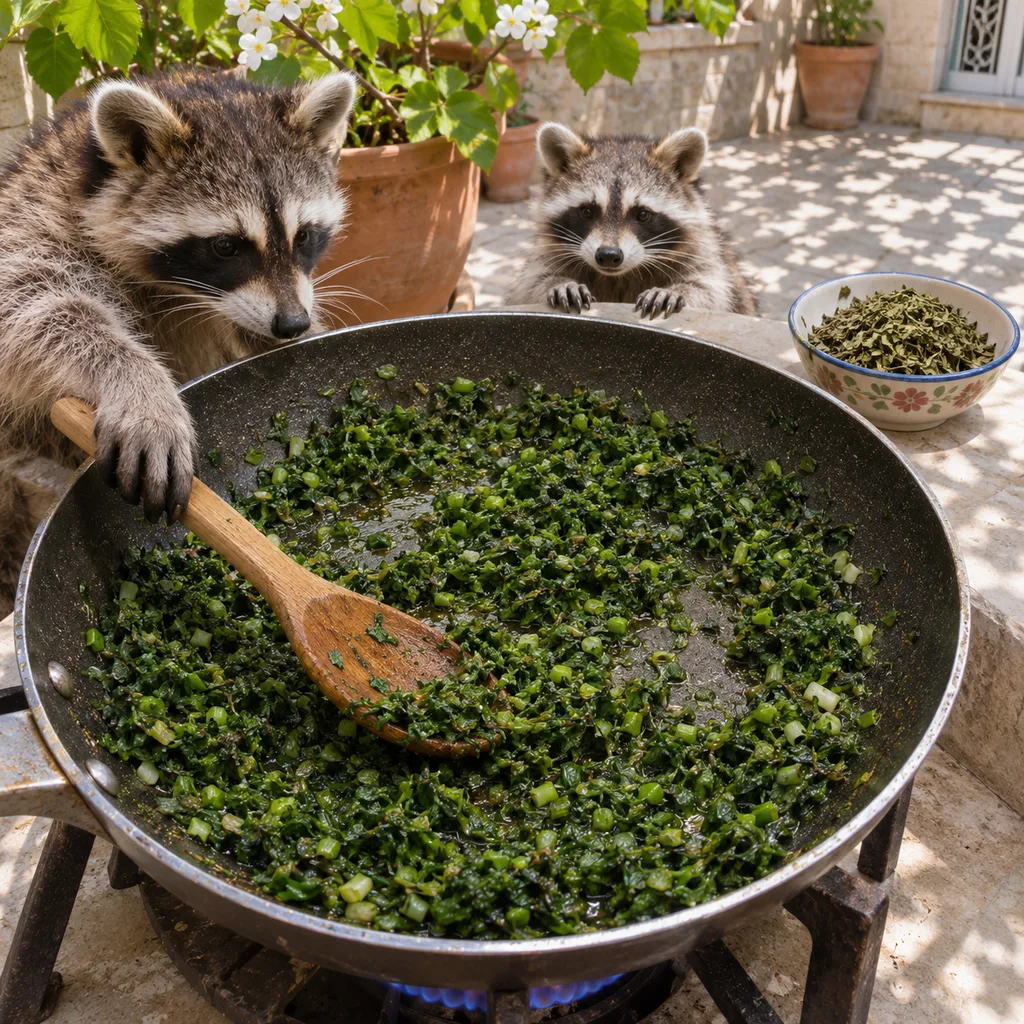
Heat the remaining 30 ml oil in the broad frying pan over medium heat. Add the chopped fresh herbs in two or three handfuls, stirring as each collapses. Cook for 18 to 25 minutes, stirring frequently and scraping the edges, until steam has greatly reduced, the colour is dark green and the mixture looks glossy rather than watery. Lower the heat if the edges dry faster than the centre. Add the dried fenugreek only for the final 1 minute, stirring constantly. It should smell aromatic, without black or scorched patches.
4. Simmer until the beef softens
Scrape the herbs and their oil into the casserole. Rinse the frying pan with 50 ml hot water and add that liquid too. Stir, cover with the lid slightly ajar and simmer very gently for 75 to 105 minutes. A few small bubbles should break the surface; a rolling boil toughens the outside of the meat and evaporates the sauce too quickly. Stir every 20 minutes. If the herbs begin sticking or the liquid falls well below the solids, add hot water in 100 ml portions. The beef should be nearly tender before you add the final ingredients.
5. Add beans and dried limes
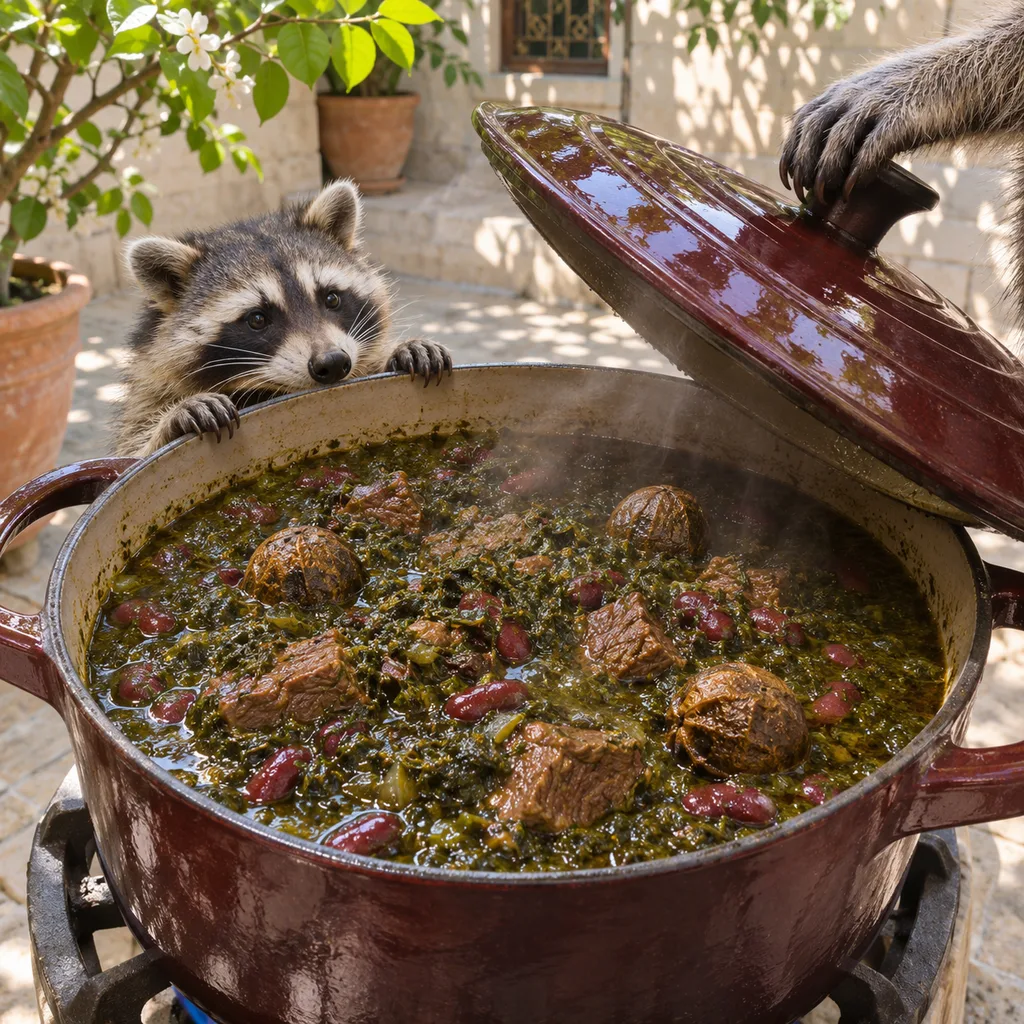
Fold in the kidney beans and pierced dried limes. Keep simmering with the lid ajar for 30 to 40 minutes, stirring gently so the beans retain their shape. Turn the limes once and taste the sauce after 20 minutes. Lift them out early if the sourness is already strong enough. The beef is ready when a fork slips into a cube and twists it apart with little resistance; check that a large cube has reached at least 63°C before the final 10-minute rest. This long braise normally exceeds that minimum; temperature alone does not establish tenderness.
6. Adjust the sauce and rest
Remove the dried limes before serving; they have flavoured the broth and are not part of the measured edible yield. If the sauce is watery, simmer uncovered for 5 to 10 minutes, stirring gently, until the herbs cling to the meat and a spoonful holds together. If too thick, loosen with 50 ml hot water. Taste and add up to the remaining 2 g salt. Turn off the heat, cover and rest for 10 minutes. Spoon into warm bowls with enough sauce for each portion.
Texture and keeping
Herbs taste burnt: blackened herbs or fenugreek make the whole pot bitter. Stop before combining a scorched herb pan with the beef; restart that herb mixture with the measured ingredients. Extra lime will not remove a burnt flavour.
Meat still firm: add 100 ml hot water, cover and continue at a gentle simmer for 15 minutes before checking again. Keep the beans out until the beef is nearly tender so they do not break down during an unexpectedly long braise.
Dried lime tastes too strong: remove the whole limes as soon as the sauce has enough acidity. Do not crush them into the pot or press their seeds into the sauce. Start tasting before the end of their cooking window.
For leftovers, divide the stew into shallow containers and refrigerate within 2 hours, or within 1 hour above 32°C. Keep at 4°C or below, and reheat portions to 74°C; bring the sauce to a boil while stirring. These handling points follow the FDA's safe food handling guidance. Keep any accompanying rice separate and follow its own cooling guidance.
Serve and compare
Plain steamed rice leaves room for the herb sauce. For a different rice accompaniment, use a smaller portion of Iranian jeweled rice, whose fruit and nuts add sweetness and crunch; rice is outside this stew's nutrition estimate. Kashk-e Bademjan gives another way to build a meal around an Iranian vegetable preparation.
The Iran cuisine guide places these dishes in a wider context. For another slow-cooked khoresh with a different base, Fesenjan uses walnuts and pomegranate rather than chopped herbs and dried lime.
Estimated nutrition per serving
One serving is 1/4 of the recipe. Values are rounded estimates.
- Calories
- 600 kcal
- Protein
- 38 g
- Carbohydrate
- 28 g
- Fat
- 38 g
Calculated from USDA FoodData Central, SR Legacy (April 2018) food composition data and the stated recipe yield.
How this estimate was calculated
Ingredient amounts are converted to edible weights, matched to USDA foods, added together and divided by 4 servings. Comparable foods are used where a regional ingredient has no exact record. Ingredient brands, portion sizes, discarded fat and cooking losses can change the result. Optional ingredients and unmeasured accompaniments are excluded. Sodium is not estimated because salt and brine retention vary.
- Counts trimmed raw beef chuck and all measured olive oil; trimming and rendered fat left in the pot change actual intake.
- Cooked white beans represent drained canned red kidney beans because the snapshot has no kidney-bean record. Scallion greens use the whole-scallion record.
- Dried oregano is a small-quantity composition proxy for dried fenugreek leaves, which are absent from the snapshot. It is a nutrition proxy, not an ingredient substitution.
- Whole dried limes are removed. Their variable extracted nutrients are not quantified; water and salt contribute no calculated energy or macronutrients.
- Rice and other serving accompaniments are excluded. All measured sauce is divided between four portions.