Homemade Corn Tortillas
A warm corn tortilla should bend around a filling without splitting. The dough's moisture, an even press and a short rest in the wrapped stack all help it stay supple. Start with a small batch so you can adjust the first tortilla before pressing the rest.
This is a masa harina method for Mexican tortillas de maíz. The flour is made from nixtamalized corn; ordinary cornmeal, cornstarch and the flour sold for arepas behave differently. Rick Bayless explains the distinction between fresh masa and masa harina. The measured batch below adapts the covered hydration rest and dough-consistency approach described by Masienda, with the pressing and staged cooking cues demonstrated by Pati Jinich.
Yield: 16 tortillas about 13 cm across, serving four people with four tortillas each. Allow about 1 hour 5 minutes: 15 minutes for mixing, portioning and setup, a 15-minute dough rest, about 30 minutes to press and cook, and a final 5-minute wrapped rest. Preheat during the dough rest and press the next tortillas while a pair cooks. The estimate assumes a griddle with room for two tortillas; cooking them singly can add another 10–20 minutes.
Equipment
Use a kitchen scale, mixing bowl, tortilla press, two food-safe plastic liners, a clean tea towel, a shallow basket or covered tortilla warmer and a thin metal spatula. A flat 30 cm cast-iron comal or large griddle can hold two of these tortillas without overlap. Cut the liners from a clean food-storage bag, slightly larger than the press plates. Keep plastic well away from the hot cooking surface.
Ingredients
- 🌽 240 g masa harina for corn tortillas
- 💧 360 ml warm water, about 40°C
- 🧂 3 g fine salt
Use white or yellow masa harina labelled for tortillas. Brands absorb water differently. Keep a little extra water and masa harina nearby for the small, measured corrections in the method. These corrections are separate from the base quantities and are excluded from the nutrition estimate.
Instructions
1. Mix the masa
Stir the masa harina and salt together. Add the 360 ml warm water, mix thoroughly, then knead in the bowl for about 2 minutes until no dry pockets remain. Scrape down the bowl and gather the dough into one soft mass. It should hold its shape without crumbling; the rest will give the flour more time to hydrate.
2. Rest and check the dough
Cover the bowl with a damp clean towel and leave for 15 minutes. During the last 5 minutes, heat the dry comal over medium heat. Flatten a small piece of dough into a disc between your fingers. Its edge should stay mostly smooth, and the dough should release without smearing. If the edge cracks, knead in 5 ml water at a time, up to 30 ml. If the dough is sticky and leaves a wet film, knead in 5 g masa harina at a time, up to 10 g, then cover for another 5 minutes before checking. That extra correction rest extends the total time.
3. Divide and press evenly
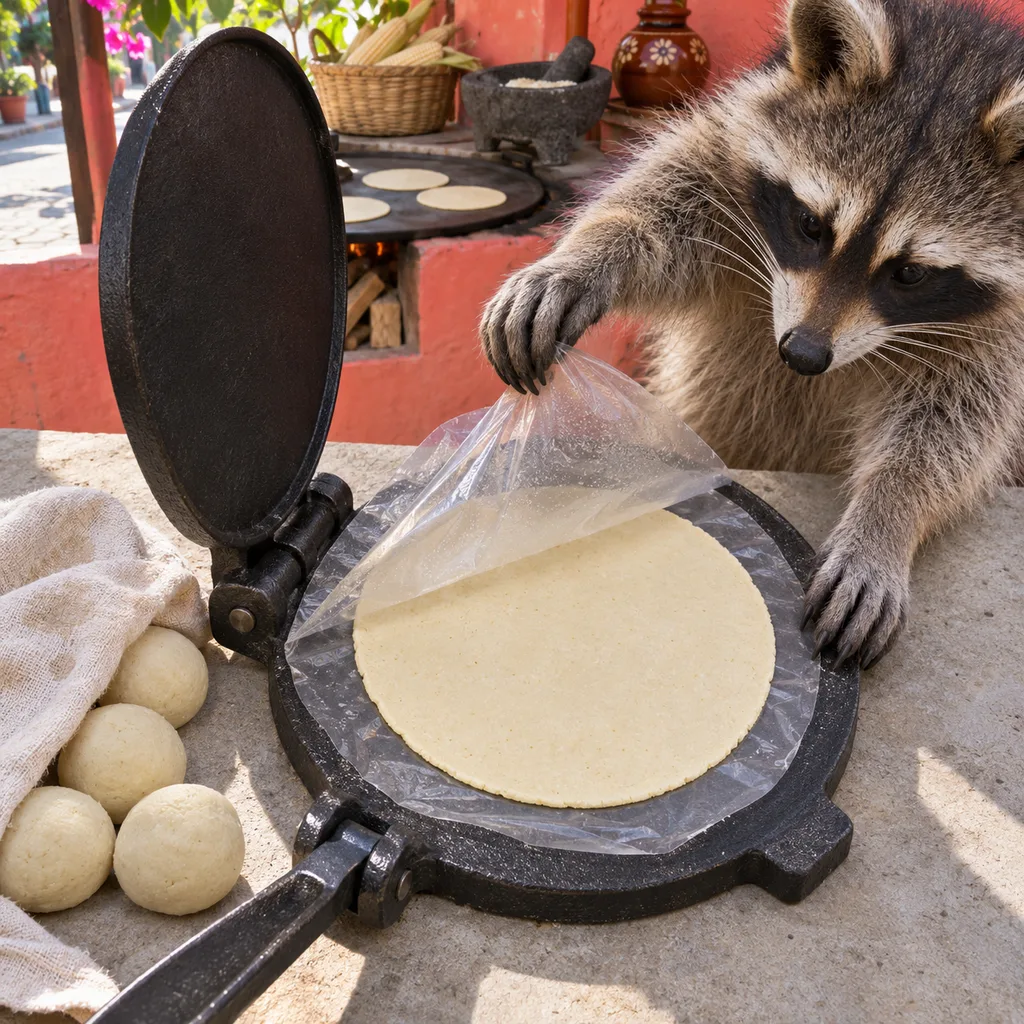
Divide the dough into 16 equal pieces, approximately 38 g each before any corrections. Roll each into a ball and keep the waiting pieces covered. Put one liner on the press, set a ball just off-centre towards the hinge, and cover with the second liner. Close the press gently, then open, rotate the lined tortilla halfway around and press once more if needed. Aim for a round about 13 cm across and 1.5–2 mm thick, with an even edge. Avoid pressing so hard that the edge becomes almost transparent.
4. Peel and set on the comal
Peel away the upper liner. Lift the tortilla on its lower liner, turn it onto an open palm, and gently peel the plastic away from the dough. Lower the tortilla onto the dry comal with a smooth motion, keeping your skin clear of the metal. Practise the peel over the counter first if needed. A folded or torn raw tortilla can be rolled into a ball and pressed again. Leave space for a second tortilla; do not overlap them or add oil.
5. Cook with two flips
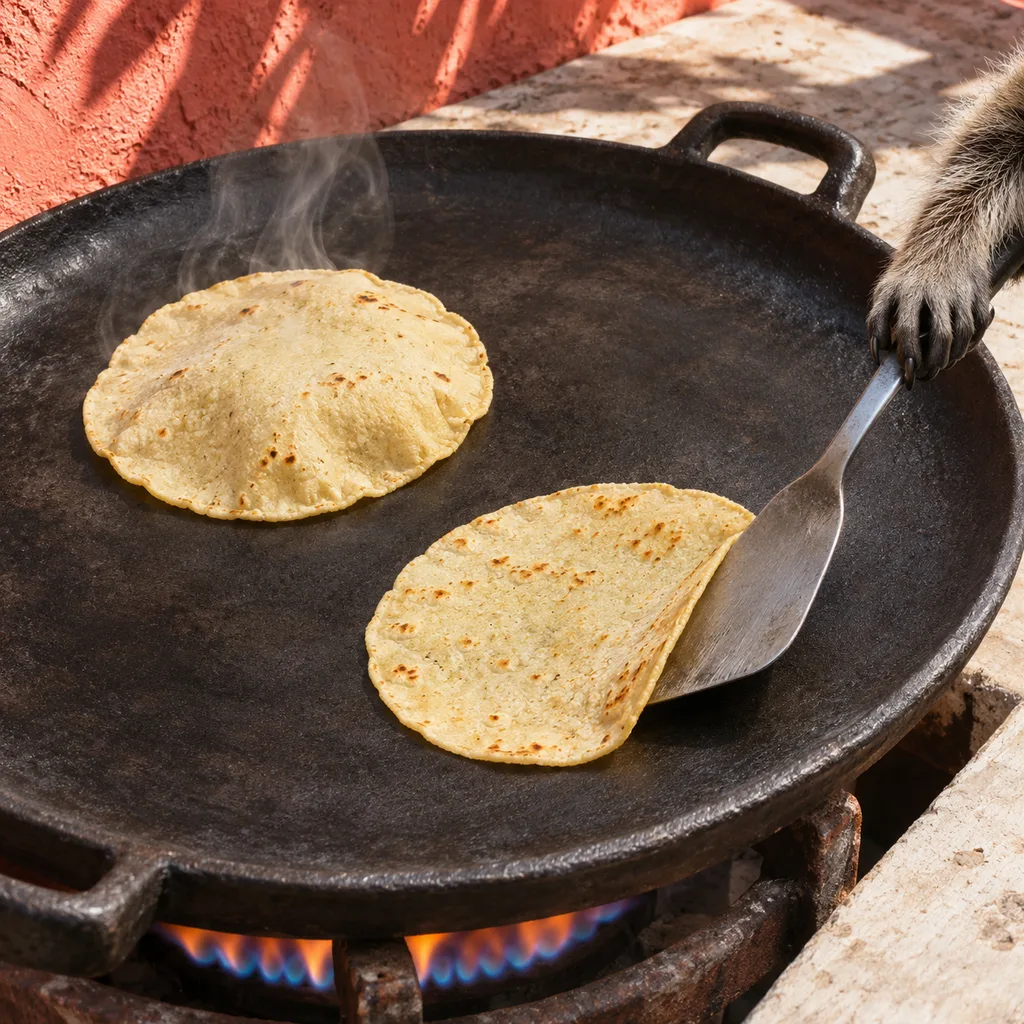
Cook the first side for about 30–45 seconds, until the surface loses its wet sheen and the tortilla releases when nudged with the spatula. Flip and cook for about 60–90 seconds, until small light-brown spots form underneath. Flip again and cook for another 20–30 seconds. It may puff partly or fully as steam separates the layers. Look for a set surface, a flexible edge and no damp raw band in the middle when you tear the first tortilla to check it. Increase or reduce the heat a little for the next batch if necessary. Press the next pair while these cook, keeping the remaining dough covered.
6. Wrap the cooked stack
Transfer each cooked tortilla straight into the towel-lined basket and fold the towel over it. Add each new tortilla to the stack and cover again. After the final pair, leave the whole stack wrapped for 5 minutes before serving. The retained steam softens the tortillas; a tortilla left uncovered on a plate will dry sooner. Keep the basket away from the hot burner.
Adjust the next tortilla
Cracked edges after pressing: work another 5 ml water into the remaining dough, cover briefly and try again. A little texture at the very edge is normal; deep splits are a reason to adjust it.
The liner will not peel: the dough may be too wet or the tortilla too thin. Use the measured flour correction above, or press the next ball less firmly. Peel the plastic back against itself rather than pulling the tortilla upwards.
Dark spots appear before the first flip: reduce the heat slightly. The first side needs time to set before browning heavily. Black brittle patches indicate scorching, not extra flavour.
No puff: check hydration, thickness and heat in that order. A small tear lets steam escape, and a very dry surface may not separate. Do not keep cooking a finished tortilla while waiting for a full balloon; wrapping matters more than a dramatic puff.
Serve, cool and reheat
Use these for fish tacos, scoop up Chile Verde, or serve a warm stack alongside mole negro. Salsa Verde gives a separate tangy topping, and Mexican rice makes another accompaniment. The Mexico food guide provides broader regional context.
For leftovers, open the towel and let the tortillas cool completely before sealing them in a container in the refrigerator. Use within three days for this home-kitchen batch. Reheat on a dry hot pan for about 15–30 seconds per side, then wrap briefly again. If they are very dry, lightly moisten each side with about 2 ml water before warming. Discard tortillas with mould or an off smell; reheating does not repair spoilage. Masienda's storage advice explains why sealing a warm stack can trap condensation.
Estimated nutrition per serving
One serving is 1/4 of the recipe. Values are rounded estimates.
- Calories
- 215 kcal
- Protein
- 4 g
- Carbohydrate
- 46 g
- Fat
- 2 g
Calculated from USDA FoodData Central, SR Legacy (April 2018) food composition data and the stated recipe yield.
How this estimate was calculated
Ingredient amounts are converted to edible weights, matched to USDA foods, added together and divided by 4 servings. Comparable foods are used where a regional ingredient has no exact record. Ingredient brands, portion sizes, discarded fat and cooking losses can change the result. Optional ingredients and unmeasured accompaniments are excluded. Sodium is not estimated because salt and brine retention vary.
- Four tortillas are one of four servings; the batch makes sixteen.
- Whole-grain yellow corn flour is the available USDA proxy for masa harina. Nixtamalization, maize variety and brand change composition; this is a macronutrient estimate, not a mineral or sodium analysis.
- Counts 240 g dry flour, with no cooking oil. Water and salt supply no energy or macronutrients in this estimate. Optional small hydration/flour corrections and serving dishes are excluded.