Chile Verde
Roasted tomatillos bring enough acidity to cut through pork shoulder's richness. Poblanos add a broader green-chile flavour, while a smaller jalapeño gives this pot its heat. The sauce thickens around the meat as the shoulder becomes tender enough to separate with a fork.
This is a home-kitchen pork and tomatillo version of chile verde. Rick Bayless's account of pork with roasted poblano and tomatillo describes the shoulder-braise tradition behind those flavours. The measured formula below uses boneless shoulder and omits cactus; it is not a claim that every Mexican or Southwestern green-chile stew follows the same recipe. The Mexico food guide gives broader regional context.
Makes six main-course portions, before rice or tortillas. Allow about 3 hours 20 minutes, including the short final rest. Shoulder varies: a 90–150-minute braise makes the whole job roughly 3–4 hours. Use the fork test rather than shortening cooking to meet the estimate. You will need a large rimmed roasting sheet, blender, tongs and a heavy 4–5 litre covered pot.
Ingredients
Pork
- 🐖 1 kg boneless pork shoulder, excess surface fat trimmed, cut into 3 cm chunks
- 🫒 30 ml olive oil
- 🧂 8 g fine salt, divided
Green sauce
- 🍃 800 g tomatillos, weighed after husking, rinsed and halved
- 🌶️ 2 poblano peppers, about 250 g whole
- 🌶️ 1 jalapeño, about 30 g after stemming and deseeding
- 🧅 180 g white onion, peeled and cut into 1 cm slices
- 🧄 4 large garlic cloves, skins on, about 20 g peeled weight
- 🌿 20 g coriander leaves and tender stems, divided
- 🌰 2 g ground cumin
- 🌿 1 g dried Mexican oregano
- 🍲 300 ml low-salt chicken broth
- 🍋 15 ml lime juice
Choose firm tomatillos with no mould beneath the husks. The weight here is the usable fruit, not a bag weighed with husks attached. Jalapeño heat varies; deseeding removes some of the hottest inner tissue, but it cannot guarantee a mild stew. Use the single measured chile for this version rather than adding an unknown number while the pot cooks.
Mexican oregano has a different flavour from Mediterranean oregano. If it is unavailable, use 1 g dried Mediterranean oregano as a substitute and expect a different herbal note. Choose broth appropriate for any dietary restrictions; a “low-salt” label does not establish that it is free of wheat or other allergens.
Instructions
1. Roast the sauce vegetables
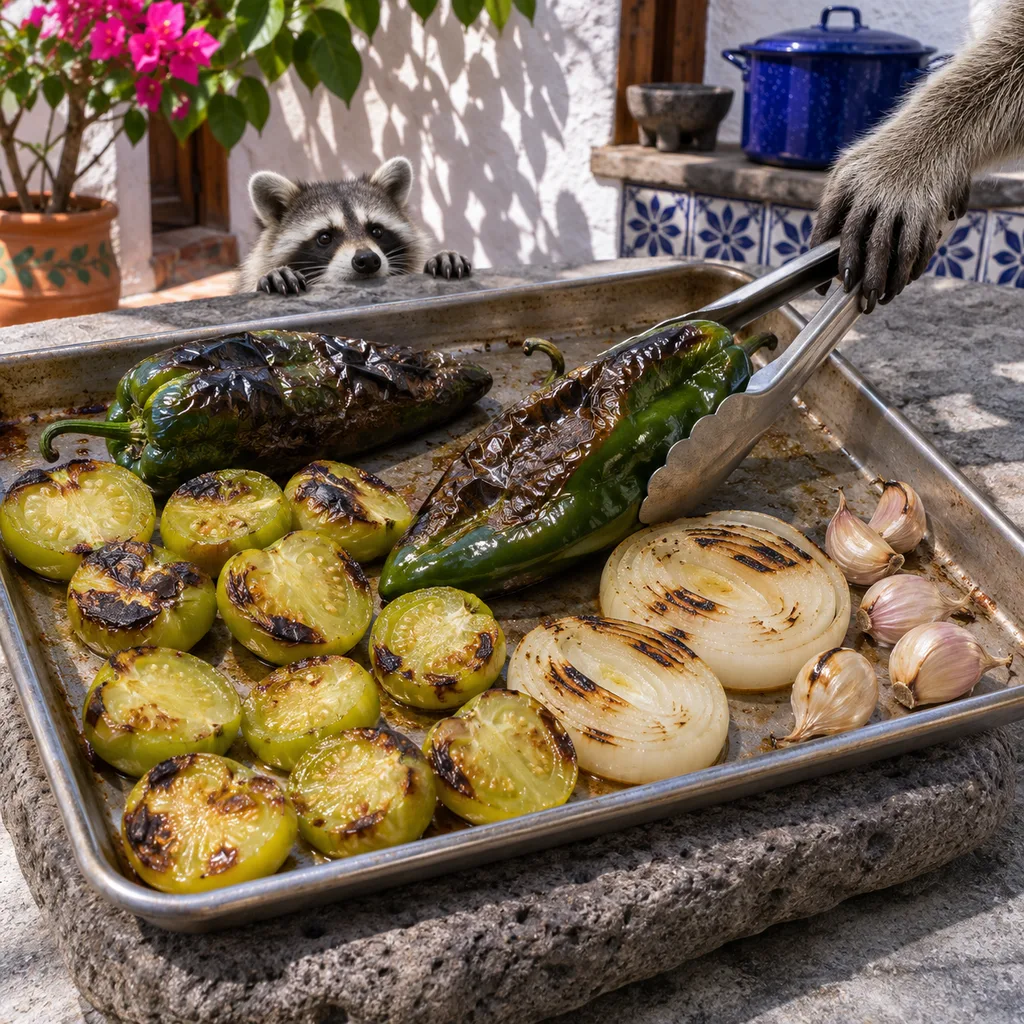
Heat the oven broiler or grill to high and position a rack about 15 cm from the element. Put the tomatillo halves cut-side up on the roasting sheet with the whole poblanos, jalapeño, onion slices and unpeeled garlic. Keep everything in one layer; use two rounds if your sheet is crowded. Do not add oil to the tray.
Broil for 15–25 minutes, turning the poblanos and onion with tongs as they colour. Remove the garlic as soon as it is soft, usually after 8–12 minutes. The tomatillos should collapse slightly and develop dark blisters; the poblanos need wrinkled, blistered skins on all sides. Move individual vegetables away from a hot spot before they burn black throughout. Retain the tray's juices.
2. Peel and blend the sauce
Put the hot poblanos in a bowl, cover with a plate and leave for 5 minutes while the garlic cools enough to handle. Rub away the loose poblano skins, remove their stems and seed clusters, then peel the garlic. Discard the jalapeño stem and inner seed-bearing tissue if not already removed.
Blend the poblanos, jalapeño, garlic, onion, tomatillos and tray juices with 10 g of the coriander and 100 ml of the broth. Use short pulses to make a coarse, pourable sauce. With hot ingredients, follow the blender manufacturer's venting and fill-limit instructions; never seal a hot mixture in a closed blending cup. Set the sauce aside.
3. Brown the pork in batches
Keep the raw pork refrigerated until this stage, and wash the board and utensils after preparing it. Pat the pork dry and season with 4 g of the salt. Heat the olive oil in the heavy pot over medium-high heat. Brown the pork in three batches, leaving space between pieces, for about 6–8 minutes per batch. Turn it when the underside has a brown crust and releases readily. Transfer each batch to a clean bowl; it will still be raw inside.
Leave the browned deposits in the pot, but lower the heat if they turn very dark or smell acrid. Do not add water to a crowded pot to hurry this stage. If the pork releases liquid and steams, let that liquid evaporate before expecting a crust.
4. Fry the sauce and start the braise
Lower the heat to medium. Carefully add the blended sauce to the pot; it may spit. Stir and scrape the bottom for 4–5 minutes, until the sauce begins to thicken and the browned deposits have dissolved. Stir in the cumin, oregano, remaining 200 ml broth and remaining 4 g salt.
Return the pork and its juices to the pot. Bring to a gentle simmer, then cover and reduce the heat to low. The sauce should reach roughly halfway to two-thirds up the meat; the pork need not float. If the pot is unusually wide and the sauce barely covers its base, add 50 ml water. Keep a little hot water available for evaporation later.
5. Simmer until the meat yields
Braise gently for 90–150 minutes, stirring every 25–30 minutes and replacing the lid. Look for occasional small bubbles, not a hard boil. If the bottom begins to catch, lower the heat, stir carefully and add 50 ml hot water. Start testing a large pork piece after 90 minutes.
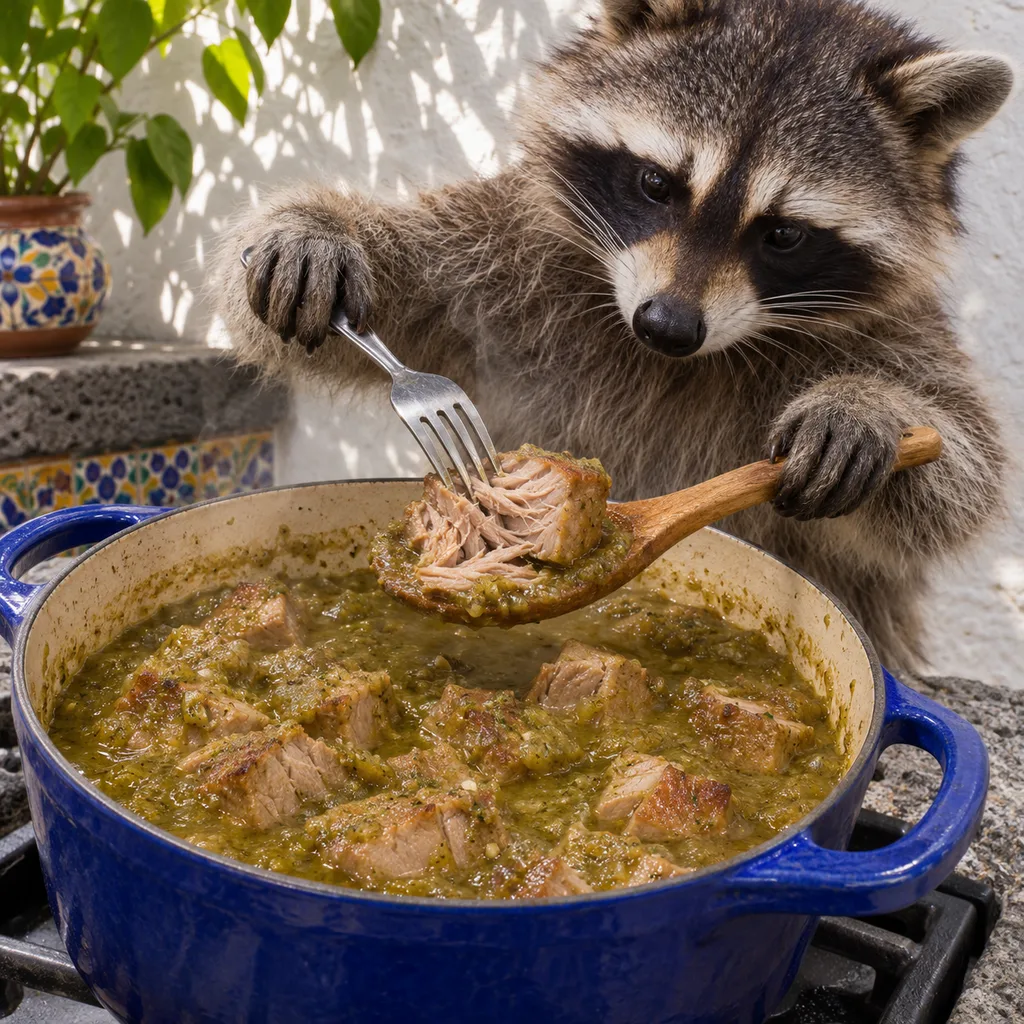
Lift a chunk onto a spoon and press it with a fork. It is ready when the fibres separate easily with little pressure while the other chunks still hold their shape. If it feels springy or resists the fork, continue covered in 15-minute intervals. Whole-cut pork has a minimum safety endpoint of 63°C followed by a 3-minute rest, but shoulder needs further cooking to become tender. Do not stop this braise at that minimum; USDA's temperature guidance distinguishes safety temperatures from a preference for further cooking.
6. Reduce, rest and finish
Once the pork is tender, uncover and simmer gently for 5–15 minutes, stirring frequently, until the sauce coats a spoon. If the meat is already very soft, lift it out with a slotted spoon while reducing the sauce, then return it. Do not boil the pork until it disintegrates just to thicken a watery sauce.
Turn off the heat and leave for 5 minutes. Stir in the lime juice and remaining 10 g coriander. Taste a spoonful of sauce with a piece of pork before deciding whether it needs more seasoning. Serve hot, dividing the meat and sauce evenly between six portions.
Serving and troubleshooting
Use homemade corn tortillas to scoop up the sauce, or serve the stew beside Mexican rice. Those accompaniments are separate recipes and are not included in this recipe's nutrition estimate. For the same tomatillo ingredient in a quicker preparation, compare Salsa Verde. Fermented salsa verde follows a different preservation process and should not replace the measured roasted sauce without changing this recipe.
A grey-green or olive sauce is normal after roasting and a long braise. Do not keep adding raw coriander to chase a bright green photograph. If the sauce tastes sharply acidic, first check the pork and sauce together and let the finished pot rest as directed. If it is still too tart for your preference, serve it with the rice or tortillas rather than changing the pot with unmeasured sugar.
Cooling and reheating
Divide leftovers into shallow containers and refrigerate promptly at 4°C or below, within 2 hours of cooking or 1 hour when the surroundings are above 32°C. Do not leave the full covered pot on the counter to cool overnight. Use refrigerated portions within 3–4 days, following USDA's leftover-handling guidance.
Reheat only the portion needed in a saucepan, adding a small splash of water to loosen the sauce. Stir until the pork reaches 74°C throughout and bring the sauce to a boil; check several pieces with a thermometer. USDA's reheating guidance gives that endpoint for leftovers. Thaw frozen portions in the refrigerator before reheating.
Estimated nutrition per serving
One serving is 1/6 of the recipe. Values are rounded estimates.
- Calories
- 490 kcal
- Protein
- 31 g
- Carbohydrate
- 12 g
- Fat
- 35 g
Calculated from USDA FoodData Central, SR Legacy (April 2018) food composition data and the stated recipe yield.
How this estimate was calculated
Ingredient amounts are converted to edible weights, matched to USDA foods, added together and divided by 6 servings. Comparable foods are used where a regional ingredient has no exact record. Ingredient brands, portion sizes, discarded fat and cooking losses can change the result. Optional ingredients and unmeasured accompaniments are excluded. Sodium is not estimated because salt and brine retention vary.
- The pork calculation includes all starting meat fat and cooking oil. Trimming, meat fat content and sauce left on the plate can change the amount eaten.
- Tomatillos use raw red tomato as an available USDA snapshot proxy; poblano flesh uses raw green sweet pepper. Their nutrient composition differs from those proxies.
- Poblanos assume 210 g edible flesh from 250 g whole peppers; garlic assumes 20 g peeled edible weight for four large cloves.
- Standard chicken broth approximates the low-salt product for macronutrients; sodium is not calculated. Rice, tortillas and unmeasured extra seasoning are excluded.