Salmon Nigiri
A thin salmon topping should drape over a small oval of rice that holds together when lifted, then separates easily when eaten. Light pressure matters more than a perfectly even shape. This recipe makes 16 nigiri, two light main-course portions of eight pieces each.
Nigiri is Japanese hand-shaped sushi. The shaping sequence here follows Kikkoman's nigiri-zushi method, using salmon without its additional prawn topping. The rice method draws on Kikkoman's sushi rice recipe, with less sugar and salt in the seasoning. This is a measured home version, not a claim to reproduce a particular sushi counter. See the Japan guide for wider cooking context.
The main recipe uses raw salmon. Read the sourcing section before buying fish. For children, pregnant people, older adults or anyone with a weakened immune system, use the fully cooked option below. Raw seafood retains a foodborne-illness risk even after parasite-control freezing; the FDA seafood guide explains why these groups should avoid it.
Allow 1 hour 45 minutes: 10 minutes rinsing and draining, a 20-minute rice soak, 25 minutes heating and simmering, a 10-minute covered rest, up to 15 minutes cooling and about 25 minutes slicing and shaping. Prepare the seasoning and equipment during the rice cooking; about 40 minutes of the total is active work. This starts with fully thawed fish. If frozen, add the supplier's refrigerator-thawing time, commonly overnight, to the elapsed time; do not thaw it on the counter.
Choose salmon for raw service
Ask a reputable fish supplier for a skinless, boneless salmon loin specifically prepared for eating raw. Obtain confirmation of the parasite-control treatment, including commercial freezing where required, or documented controlled-aquaculture exemption, and suitable handling for raw service. A “sushi-grade” or “sashimi-grade” label alone is not that confirmation. Farmed salmon is not automatically an exemption. If the supplier cannot verify these points, buy salmon for the cooked option instead.
Do not assume a domestic freezer achieves a validated commercial parasite-control process. Temperature, time and the whole thickness of the fish matter. Citrus, vinegar, salt and wasabi are seasonings, not disinfection. The FDA's parasite guidance explains the limits of freezing, brining and pickling; the Food Safety Authority of Ireland's sushi guidance describes the need for verified freezing conditions and supplier records.
Transport fish cold and keep it covered at 4°C or below, separate from ready-to-eat food. Follow the supplier's use-by and thawing instructions and make this recipe on the day the fish is ready. Wash hands before and after handling fish. Use separate clean equipment for rice and fish, then wash the fish board, knife and worktop thoroughly. Food Standards Australia New Zealand gives practical buying, cold-storage and cross-contamination guidance.
Ingredients
Rice
- 🍚 150 g dry Japanese short-grain white rice
- 💧 210 ml cold water, plus water for rinsing
- 🍶 30 ml unseasoned rice vinegar
- 🍬 12 g caster sugar
- 🧂 2 g fine salt
Salmon and shaping
- 🐟 240 g skinless, boneless salmon loin, trimmed edible weight, prepared for raw service and fully thawed
- 💧 200 ml cold water, for moistening hands
- 🍶 10 ml unseasoned rice vinegar, for moistening hands
- 🌶️ 2 g prepared wasabi, optional
To serve
- 🥢 15 ml Japanese soy sauce, optional
- 🫚 20 g drained pickled ginger, optional
Use ordinary unseasoned rice vinegar; seasoned sushi vinegar already contains sugar and salt. Short-grain rice is important for the cohesive texture. The 240 g salmon is the amount after removing skin, pin bones and tough edges; ask the supplier to trim a little extra shopping weight if necessary. Soy sauce usually contains wheat; check the label if avoiding gluten. Fish and soy are allergens.
Have a small heavy saucepan with a tight lid, a wide non-metallic mixing bowl, rice paddle, kitchen scale, sharp long knife, stable cutting board and a clean damp cloth ready. A digital food thermometer is necessary for the cooked option.
Instructions
1. Rinse and soak the rice
Put the 150 g rice in a bowl, cover with cold rinsing water and swish gently. Drain and repeat three or four times until the water is much less cloudy. Drain in a fine sieve for 5 minutes. Transfer to the saucepan with exactly 210 ml fresh cold water. Soak for 20 minutes with the lid on.
2. Cook and rest covered
Bring the covered pan to a gentle boil over medium heat, about 5 minutes. Reduce to the lowest heat and simmer, covered, for about 20 minutes, until the water is absorbed. Avoid lifting the lid during cooking. Take the pan off the heat and start a one-hour cooling-and-serving timer. Rest for 10 minutes, still covered. The grains should be tender through the centre and distinct, without standing water. If the rice is firm and the pan dry, sprinkle over 15 ml boiling water, cover and cook on low for 3–5 minutes, then rest another 5 minutes. This recovery adds time.
3. Season and cool promptly
While the rice cooks, warm the 30 ml vinegar, 12 g sugar and 2 g salt in a small pan just until dissolved, without boiling. Let this mixture cool. Transfer the rested hot rice to the wide bowl and pour the seasoning evenly over it. Fold with the edge of the paddle, lifting and turning rather than stirring or crushing. Fan gently for 10–15 minutes until the rice is glossy and barely warm, about 30–35°C. Cover briefly with the damp cloth while slicing the salmon.
4. Slice the cold salmon
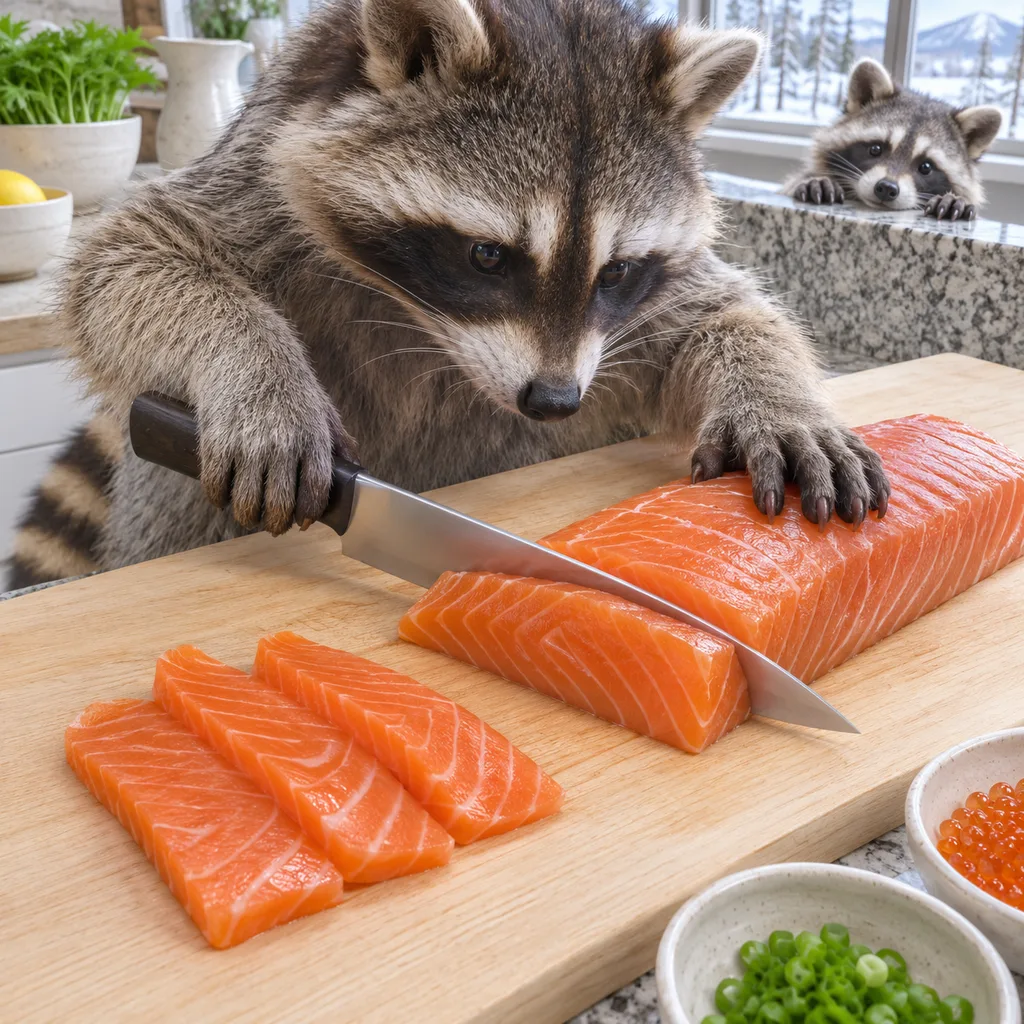
Keep the salmon refrigerated until the rice is ready. Pat it dry with disposable kitchen paper. On the separate fish board, remove any remaining pin bones and identify the direction of the muscle fibres. Angle the blade and draw it towards you in one long smooth stroke across the grain to make 16 broad slices, about 15 g each. Aim for roughly 6–7 cm long, 3 cm wide and 5–7 mm thick, adjusting for the loin's shape. Keep supporting fingers curled behind the blade. Avoid sawing. Put the slices on a covered chilled plate and return them to the refrigerator while portioning rice.
5. Portion the rice lightly
Mix the 200 ml hand water and 10 ml vinegar in a small bowl. This keeps rice from sticking; it does not sanitise hands. Lightly wet clean hands and shake off excess water. Weigh the entire seasoned rice batch, then divide it into 16 equal portions, usually about 22–25 g each. Use all the rice rather than adding an uncounted bowl alongside. Gently gather each portion into an oval about 4 cm long. Do not squeeze it into a dense ball.
6. Shape salmon over rice
Work with four cold salmon slices at a time, leaving the remainder refrigerated. Lay one slice across your cupped non-dominant palm. If using wasabi, spread a tiny dab on its centre, sharing the 2 g across all 16 pieces. Set a rice oval on the salmon. With two fingertips, press the rice very gently against the fish, supporting the ends so it stays centred. Turn it over so the salmon faces up, then lightly straighten the sides. The fish should cover the top and drape just beyond the rice. Place it on the serving plate and repeat, lightly moistening your hands as needed.

7. Serve without holding
Serve all 16 pieces immediately, with the optional soy sauce and ginger in separate small dishes. A small dip of the fish side into soy sauce keeps the rice from soaking and collapsing. Finish shaping and eating within one hour of taking the rice pan off the heat. Keep unused fish cold throughout; do not leave a raw-fish platter out for later grazing.
Fully cooked salmon option
Use 240 g skinless, boneless salmon intended for cooking, with the same rice and seasoning quantities. Cut it into four even pieces about 2 cm thick. Put them in a single layer on a heatproof plate in a covered steamer over simmering water. Steam for approximately 8–12 minutes, checking early, until the centre of every piece reaches 63°C. Use the thermometer in the thickest part; colour alone is not the endpoint. Add cooking time as needed for thicker pieces. This follows the endpoint in the FDA seafood guide.
Cook during the rice simmer and rest. Move the fish to a clean plate with clean utensils, let it cool for about 10 minutes until comfortable to handle, then divide into 16 portions. Shape the rice ovals and set a cooked portion on each with a clean spoon. It will flake rather than drape like a raw slice. If it will not stay on top, serve the 16 rice ovals and cooked salmon portions side by side. This is fully cooked salmon with sushi rice, not raw nigiri. The work fits the 1-hour-45-minute schedule when done alongside the rice; allow another 20–25 minutes if cooking it after the rice is ready.
Texture and storage notes
Rice sticks everywhere: use a little more hand water, then shake off excess. Wet hands should not drip onto the rice. Keep the bowl covered briefly between portions so the surface does not crust.
Nigiri crumbles: use slightly more pressure at the sides and make sure the salmon lies across the oval. If the rice is cold and hard or already mushy, forcing the shape will not repair it. Serve the components in bowls rather than repeatedly squeezing them.
Rice safety: the vinegar amount here is for flavour, not a validated acidification process. Cooked rice can support Bacillus cereus growth if left warm. Make only what you will eat now. Refrigerate any untouched surplus rice promptly in a shallow covered container, within one hour of cooking, use within 24 hours and reheat once until steaming throughout. Refrigeration makes sushi rice firmer, but leaving it out to preserve texture is not a safe storage method. Do not save assembled raw nigiri for another meal. The Food Standards Agency's rice advice explains rapid cooling and single reheating.
Serve cucumber sunomono as a separate vegetable side. The sushi rice guide offers more texture context; follow this recipe's measured batch and storage directions here. For a different way to encounter sushi, see the sourced Tsukiji sushi breakfast guide. The Japanese breakfast guide explains the separate tradition of plain rice with several accompaniments.
Estimated nutrition per serving
One serving is 1/2 of the recipe. Values are rounded estimates.
- Calories
- 545 kcal
- Protein
- 29 g
- Carbohydrate
- 66 g
- Fat
- 16 g
Calculated from USDA FoodData Central, SR Legacy (April 2018) food composition data and the stated recipe yield.
How this estimate was calculated
Ingredient amounts are converted to edible weights, matched to USDA foods, added together and divided by 2 servings. Comparable foods are used where a regional ingredient has no exact record. Ingredient brands, portion sizes, discarded fat and cooking losses can change the result. Optional ingredients and unmeasured accompaniments are excluded. Sodium is not estimated because salt and brine retention vary.
- Estimate covers the raw salmon recipe, eight of the sixteen nigiri per serving; all dry rice and all rice seasoning are allocated across the sixteen pieces.
- Salmon uses the USDA raw farmed Atlantic salmon record at 240 g trimmed skinless, boneless edible weight; wild species and cuts vary in fat content.
- Unseasoned rice vinegar is represented by cider vinegar from the available USDA snapshot at 1 g per ml; all 30 ml seasoning vinegar and 12 g sugar are counted.
- Rinsing and cooking water, hand-moistening water and vinegar, and salt have no counted energy or macronutrients. Optional wasabi, soy sauce, pickled ginger and other sides are excluded.
- The fully cooked salmon option is not calculated separately; the estimate assumes the primary raw version, with no cooking losses.