Japchae
Sweet potato starch noodles turn translucent as they cook, then take on the soy sauce's brown tint. Their soft, springy bite sits alongside tender beef, browned mushrooms and vegetables that still have some shape. Cook each component on its own before mixing, so the spinach stays green and the carrots keep a little resistance.
Japchae belongs on a shared Korean table. Maangchi's recipe describes its place at parties and explains the separate cooking approach. The Institute of Traditional Korean Food recipe published by Korea.net uses a wider vegetable selection and an egg garnish. This home version uses beef, fresh shiitake, spinach, carrot and red pepper, without the egg garnish. For the surrounding sauces and side dishes, read the Korean cuisine guide.
Makes four modest main-course portions, or eight small portions alongside other dishes. Nutrition uses four servings. Allow about 65 minutes: 25 minutes of preparation, 35 minutes at the stove and 5 minutes for the finished noodles to settle. The beef's 10-minute marinade overlaps the vegetable preparation; there is no overnight wait. You need a large saucepan, colander, 28–30 cm frying pan, large mixing bowl, kitchen scissors and several holding plates.
Ingredients
Beef and marinade
- 🥩 200 g boneless beef sirloin, trimmed and sliced across the grain into 3 mm strips
- 🥢 10 ml regular soy sauce
- 🍬 5 g granulated sugar
- 🧄 3 g peeled garlic, finely minced
- 🌰 5 ml toasted sesame oil
Noodles and vegetables
- 🍜 200 g Korean sweet potato starch glass noodles (dangmyeon), dry
- 🥬 150 g spinach, tough stems removed
- 🥕 100 g carrot, peeled and cut into 3 mm matchsticks
- 🧅 150 g peeled onion, thinly sliced
- 🫑 100 g red bell pepper, cored and cut into thin strips
- 🍄 120 g fresh shiitake mushroom caps, sliced 5 mm thick
- 🌱 30 g scallions, trimmed and cut into 4 cm lengths
- 🌻 25 ml neutral cooking oil, divided
- 🌰 5 ml toasted sesame oil
- 🧂 2 g fine salt, divided
- 💧 2 litres water, plus extra for rinsing
Dressing and finish
- 🥢 45 ml regular soy sauce
- 🍬 20 g granulated sugar
- 🧄 9 g peeled garlic, finely minced
- 🌰 20 ml toasted sesame oil
- ⚫ 0.5 g ground black pepper
- 🌰 10 g toasted sesame seeds
- 💧 30 ml water
Before you start
Buy Korean dangmyeon made from sweet potato starch, rather than rice vermicelli or mung bean threads. Similar-looking packets can contain different starches: Sempio's glass noodle information lists a sweet potato and tapioca blend. Check the ingredients when choosing a sweet potato starch noodle and follow that packet's cooking time. This method assumes an ordinary dry noodle that can be boiled without soaking.
Fresh shiitake keep the timing short. Do not replace them gram for gram with dried mushrooms, whose weight and soaking needs differ. Slice the beef against the visible muscle fibres, then cut the long slices into strips about 5 cm long. Keep the raw beef and its utensils separate from the holding plates for cooked vegetables.
Instructions
1. Marinate the beef
Mix the beef with its 10 ml soy sauce, 5 g sugar, 3 g garlic and 5 ml sesame oil in a small bowl. Refrigerate for 10 minutes while you prepare the vegetables. In a separate bowl, stir together the dressing's 45 ml soy sauce, 20 g sugar, 9 g garlic, 20 ml sesame oil and black pepper. Keep the sesame seeds and 30 ml water aside.
2. Blanch and dry the spinach
Bring the 2 litres water to a boil in the saucepan over high heat. Add the spinach and stir for 30–45 seconds, just until the leaves collapse. Lift it into a colander with a strainer, keeping the water in the pot. Rinse the spinach under cold water, let it cool enough to handle, then squeeze out the excess water. Cut it into 4–5 cm lengths and mix with 5 ml sesame oil and 0.5 g salt. Place on a holding plate. Wet spinach will dilute the final dressing.
3. Cook the noodles through
Return the saucepan water to a full boil. Add the dry noodles, submerge them and stir to separate the strands. Boil for the packet's stated time, commonly 6–8 minutes, tasting a strand near the end. It should bend easily and feel soft and elastic throughout, without a firm, chalky centre. Hyosun at Korean Bapsang explains why these noodles need thorough cooking rather than a firm pasta-like centre.
Drain, rinse briefly under cold running water and drain thoroughly for 2 minutes. Snip across the bundle two or three times with kitchen scissors to make roughly 15–20 cm lengths. Put them in the large mixing bowl and toss with half of the prepared dressing. Do not leave them sitting in rinse water.

4. Cook the vegetables separately
Heat the frying pan over medium-high heat. Add 5 ml neutral oil and the onion. Stir-fry for 2–3 minutes, until translucent with a slight bite, and season with 0.5 g salt. Transfer to a holding plate. Add another 5 ml oil and cook the carrot with 0.5 g salt for 2–3 minutes, until flexible but still lightly crisp; transfer to its own plate. Repeat with 5 ml oil, the red pepper and the remaining 0.5 g salt for 1–2 minutes. Keep these vegetables separate for now.
Add another 5 ml oil and the shiitake. Spread them out and fry for 3–4 minutes, turning occasionally, until their released moisture has evaporated and the edges have browned. Transfer to a plate. If the pan smokes or the vegetables scorch before softening, reduce the heat. Avoid adding all the vegetables together, which traps steam and makes their different cooking times difficult to judge.
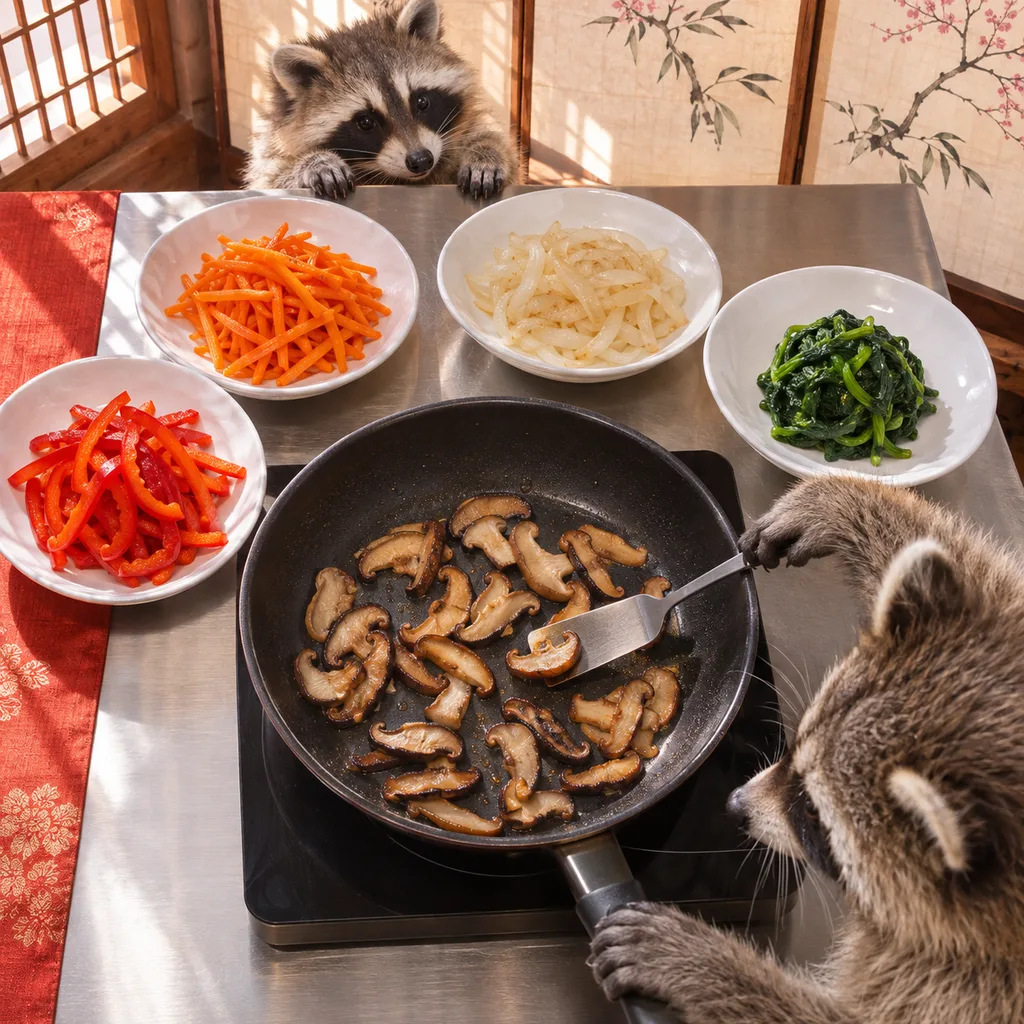
5. Cook the beef and scallions
Add the remaining 5 ml neutral oil to the empty pan over medium-high heat. Add the beef and all its marinade in a single layer. Stir-fry for 3–4 minutes, separating the strips, until browned and cooked through; aim for 71°C in the thickest strip with a fine-tip thermometer. Add the scallions for the final 30 seconds. Transfer both to a clean plate. If the sugary marinade starts catching on the pan, lower the heat and add a splash from the measured 30 ml finishing water.
6. Warm and season the noodles
Reduce the heat to medium. Add the dressed noodles, the rest of the dressing and the remaining finishing water to the pan. Toss with tongs for 2–3 minutes, lifting and loosening the strands, until hot, glossy and evenly brown. There should be no pool of liquid underneath. If the pan has a hard blackened patch from the beef, wash it first so the noodles do not pick up a burnt taste.
7. Mix and serve
Return the hot noodles to the large mixing bowl. Add the spinach, separately cooked vegetables, beef, scallions and sesame seeds. Toss thoroughly with tongs, drawing the ingredients up from the bottom until evenly distributed. Leave for 5 minutes so the dressing settles over the noodles, then toss once more and transfer to a platter. Serve warm rather than letting the dish stand out for a long gathering.
Texture and adjustments
If a noodle is stiff at the centre, keep boiling and taste again after 1 minute. Sauce will not reliably soften an undercooked bundle in the short final pan stage. If the drained noodles stick together, loosen them with the measured dressing and tongs before reheating. For noodles that have dried out in the pan, add 15 ml hot water at a time and toss briefly, stopping as soon as they separate.
For a vegetarian version, omit the 200 g beef and its entire marinade. Increase the fresh shiitake from 120 g to 250 g, cooking them in two batches with 5 ml neutral oil per batch. Keep the total neutral oil at 25 ml: the extra mushroom batch uses the 5 ml otherwise assigned to beef. Add the scallions during the final 30 seconds of the second mushroom batch. Everything else stays the same; allow about 5 extra minutes of cooking. The displayed nutrition describes the beef version.
Serving and keeping
A small dish of Korean Kimchi adds acidity alongside the sweet soy seasoning. For a shared meal, Korean scallion pancakes provide a crisp contrast. Bibimbap uses the same useful habit of cooking vegetables in stages, then combines them with rice instead of noodles. These accompaniments are separate from this recipe's yield and nutrition estimate.
Refrigerate leftovers promptly in shallow containers within 2 hours, or within 1 hour above 32°C, and keep at 4°C or colder. Use within 3 days. These limits follow USDA guidance on handling leftovers. Reheat a portion in a covered pan over medium heat with 15–30 ml water, lifting and turning the strands until loose and hot. Check that it reaches 74°C throughout, following USDA reheating guidance.
Estimated nutrition per serving
One serving is 1/4 of the recipe. Values are rounded estimates.
- Calories
- 500 kcal
- Protein
- 15 g
- Carbohydrate
- 65 g
- Fat
- 21 g
Calculated from USDA FoodData Central, SR Legacy (April 2018) food composition data and the stated recipe yield.
How this estimate was calculated
Ingredient amounts are converted to edible weights, matched to USDA foods, added together and divided by 4 servings. Comparable foods are used where a regional ingredient has no exact record. Ingredient brands, portion sizes, discarded fat and cooking losses can change the result. Optional ingredients and unmeasured accompaniments are excluded. Sodium is not estimated because salt and brine retention vary.
- Uses the beef version and four main-course servings; all measured marinade, dressing, sesame seeds and cooking oils count in full. Side dishes and the vegetarian alternative are excluded.
- Dry sweet potato starch noodles use USDA cornstarch as an available starch-only proxy. The 200 g is weighed dry, before absorbed cooking water; actual brands may have lower energy and carbohydrate.
- Fresh shiitake use raw white mushrooms as the available snapshot proxy. Beef uses raw top sirloin steak including separable fat; trimming and rendered-fat losses vary.
- Neutral cooking oil uses olive oil as a macronutrient proxy; toasted sesame oil and seeds use sesame cooking oil and dried whole sesame records. No oil left in the pan or blanching losses are deducted.